




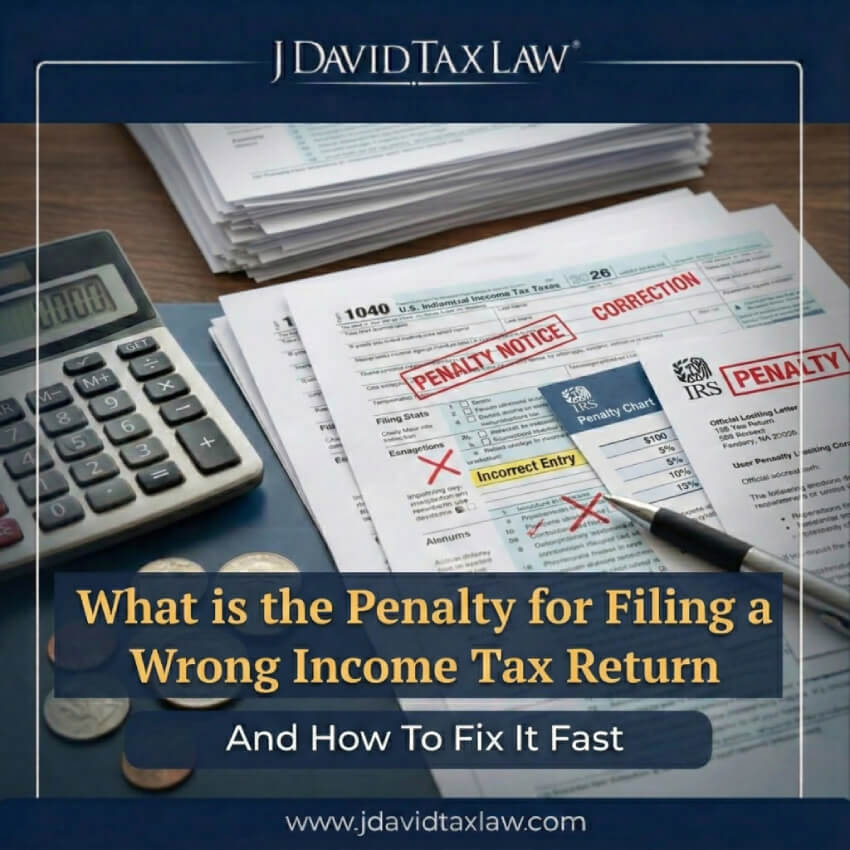
If you file an incorrect income tax return and it results in an underpayment of tax, the IRS can assess an accuracy related penalty equal to 20% of the underpaid amount for negligence, disregard of rules, or a substantial understatement. If the IRS determines the underpayment is due to fraud, it can add a 75% fraud penalty on the portion of tax due to fraud.
Separate from “wrong return” penalties, if you do not file on time and you owe tax, the IRS can charge a failure to file penalty that accrues up to 25 percent, and if you file but do not pay on time, it can charge a failure to pay penalty of 0.5 percent per month (reduced to 0.25 percent per month during an approved payment plan).
Penalty for Filing a Wrong Income Tax Return
The penalty for filing a wrong income tax return depends on the type of error and whether tax was underpaid. Here is a clear breakdown:
- No penalty if the IRS corrects minor math or clerical errors and there is no underpayment of tax.
- 20% accuracy-related penalty if the underpayment is due to negligence, disregard of IRS rules, or a substantial understatement of income tax.
- 75% civil fraud penalty if part of the underpayment is due to intentional fraud.
Can You Get in Trouble for Incorrectly Filing Taxes?
Yes, you can get in trouble for incorrectly filing taxes, but the consequences depend on why the return was wrong and whether tax was underpaid.
In most situations, filing an incorrect tax return is a civil issue, not a criminal one. If the mistake results in underreported income or unpaid tax, the IRS may assess penalties and interest. However, honest errors are generally handled through corrections, penalty assessments, or payment arrangements — not prosecution.
The IRS distinguishes between three levels of conduct:
- Honest mistake: Math errors, missing forms, or unintentional reporting errors. These are typically corrected through IRS notices or amended returns.
- Negligence or disregard of rules: Failing to make a reasonable effort to follow tax laws. This can trigger a 20 percent accuracy-related penalty.
- Willful fraud: Intentionally falsifying income, deductions, or credits to reduce tax liability. This can result in a 75 percent civil fraud penalty and, in serious cases, criminal investigation.
Jail risk arises only when there is intentional tax evasion or fraud, not when a taxpayer makes a good-faith mistake and takes steps to correct it.
If an error was unintentional, the IRS often allows taxpayers to correct the return and may grant penalty relief in certain circumstances. Intent is the key factor in determining whether the issue remains civil or escalates into something more serious.
The IRS is Forgiving Millions Each Day. You Could Be Next.
Does the IRS Forgive Honest Mistakes?
In many cases, yes the IRS does not automatically punish honest mistakes. Whether penalties apply depends on the type of error, whether tax was underpaid, and how quickly the issue is corrected.
Here’s how the IRS typically handles good-faith errors:
IRS Corrects Math Errors Automatically
If your return contains simple math mistakes or clerical errors, such as addition errors, missing Social Security numbers, or minor entry mistakes, the IRS often corrects them during processing.
In these situations:
- You usually do not need to file an amended return
- The IRS will send a notice explaining the adjustment
- You either receive a revised refund or a bill for any difference
These types of corrections typically do not trigger accuracy-related penalties, unless they result in a substantial underpayment tied to negligence.
No Penalty If There Is No Underpayment
The IRS generally imposes penalties only when an incorrect return causes an underpayment of tax.
If:
- The mistake did not change the tax owed, or
- The correction results in a refund,
then penalties usually do not apply. Penalties are primarily tied to:
- Underreported income
- Overstated deductions or credits
- Failure to pay tax owed
If no tax was underpaid, there is typically no accuracy-related penalty.
How to Remove or Reduce IRS Penalties for Filing a Wrong Return?
If the IRS has assessed penalties for filing a wrong income tax return, those penalties are not necessarily permanent. In certain situations, they can be reduced or removed if you meet specific eligibility standards and take timely action.The following are the primary ways taxpayers may seek to have IRS penalties reduced or eliminated.
Not Sure How Much You Owe?
Use our FREE easy to use tax penalty & interest calculator today
First-Time Penalty Abatement (Administrative Relief)
The IRS may remove certain penalties if you have maintained a clean compliance history. This form of relief is administrative, it is based on prior compliance, not hardship.
To qualify, you generally must:
- Have filed all required tax returns
- Have paid the tax owed or entered into a payment arrangement
- Have no significant penalties in the previous three years
This type of waiver typically applies to failure-to-file and failure-to-pay penalties. It does not automatically apply to fraud penalties, and it does not eliminate the underlying tax owed. Because it is compliance-based, eligibility can often be determined quickly once your filing history is reviewed.
If you are facing significant penalties or have had a penalty abatement request denied, you may still have options. In one case, we secured a full waiver of more than $150,000 in penalties and interest for a client after prior requests had been rejected. Our tax attorneys know how the IRS evaluates these cases and can position your request to meet approval.
Reasonable Cause Relief
If you do not qualify for administrative relief, penalties may still be removed if you can demonstrate reasonable cause. The legal standard is not simply that you made a mistake. The standard is that you exercised ordinary business care and prudence but were nevertheless unable to comply.
Qualifying circumstances may include:
- Serious illness
- Natural disaster
- Death of an immediate family member
- Reliance on incorrect written IRS advice
- Other events beyond your control
Documentation is critical. General explanations or unsupported statements are usually insufficient. The IRS evaluates facts carefully, and successful relief requests are typically supported by clear records and evidence.
Can Interest Be Removed?
Interest is treated differently from penalties.
In most cases:
- Interest cannot be removed solely due to hardship
- Interest continues to accrue until the underlying tax is paid
- Interest may be reduced indirectly if the related penalty is removed
Because interest compounds daily, resolving the underlying liability quickly is often the most effective way to limit additional costs.
Payment Options That Can Prevent Escalation
If penalties have been assessed and the tax cannot be paid immediately, structured resolution options may prevent further enforcement action and limit additional penalties.
A formal payment plan allows taxpayers to pay the balance over time. While interest generally continues, entering into an approved agreement can reduce certain ongoing penalty rates and prevent more aggressive collection action.
In qualifying cases, taxpayers may settle their tax debt for less than the full amount owed. This option is eligibility-based and requires financial disclosure and documentation. It is not a negotiation tool in every case, but when appropriate, it can significantly reduce overall liability.
If a taxpayer is experiencing financial hardship, the IRS may temporarily suspend collection activity. While interest continues to accrue, enforcement actions such as levies may be paused during the hardship period.
What Counts as Misreporting Income?
Misreporting income does not only mean intentionally hiding earnings. In IRS terms, it includes any incorrect reporting that results in understated tax liability. If the error causes you to pay less tax than you legally owe, penalties may apply, particularly under the accuracy-related penalty rules.
Below are the most common situations that trigger misreporting issues:
One of the most frequent causes of IRS penalties is failing to report income that was already reported to the IRS by a third party.
This includes:
- W-2 wages from an employer
- 1099-NEC income from contract work
- 1099-MISC or 1099-K payments
- 1099-INT or 1099-DIV investment income
- Brokerage statements and capital gains
Because employers and financial institutions submit copies of these forms directly to the IRS, mismatches are often detected automatically through income matching systems. Even unintentional omissions can result in penalty assessments if tax was underpaid.
Misreporting also occurs when deductions or credits are overstated.
Common examples include:
- Claiming business expenses without proper documentation
- Taking credits you do not qualify for
- Inflating charitable contributions
- Improperly claiming dependents
If the IRS determines that deductions were claimed without reasonable basis, it may assess a 20 percent accuracy-related penalty.
Selecting the wrong filing status can significantly change tax liability.
Examples include:
- Claiming Head of Household without qualifying dependents
- Filing separately when income or dependency rules were not met
If the incorrect status reduces the tax owed improperly, the IRS may treat the difference as an underpayment subject to penalties.
A substantial understatement occurs when the amount of tax you reported is significantly less than what should have been reported.
In general terms, this applies when:
- The understatement exceeds a defined percentage threshold, or
- The understatement exceeds a specific dollar threshold
When this standard is met, the IRS may impose a 20 percent accuracy-related penalty unless you can demonstrate reasonable cause or substantial authority for your position.
Misreporting income does not automatically mean fraud. However, when incorrect reporting results in unpaid tax, the IRS has clear authority to assess penalties under the accuracy-related penalty rules. The key factors are the size of the understatement, the reason for the error, and whether the taxpayer acted reasonably under the circumstances.
Will the IRS Catch a Mistake on Your Tax Return?
In many cases, yes. The IRS uses automated systems and internal review processes to compare what you report on your return with information it receives from employers, banks, brokerage firms, and other third parties. If a discrepancy is detected, the IRS can issue a notice, assess additional tax, and apply penalties and interest where appropriate. Understanding how this process works helps you respond before the issue escalates.
The IRS receives copies of most income documents filed under your Social Security number, including W-2 forms, 1099 forms, and brokerage statements. These forms are entered into an automated matching system that compares third-party reports to the income shown on your tax return.
If the system detects missing income, overstated withholding, or other inconsistencies, it flags the return for further review. Many underreporting issues are identified through this automated process, even when the omission was unintentional.
When the IRS believes income was underreported, it commonly issues a CP2000 notice. This is not an audit, but it proposes changes based on discrepancies between your return and IRS records.
A CP2000 notice typically:
- Identifies the income the IRS believes was not reported
- Calculates the proposed additional tax
- Includes proposed penalties and interest
- Provides a deadline to respond
You generally have the option to agree, partially agree, or dispute the proposed changes. Failing to respond can result in the IRS assessing the additional tax automatically.
Some incorrect returns are selected for audit rather than handled through automated matching. Audits may be triggered by large discrepancies, unusual deductions, high-risk credits, or statistical scoring models.
During an audit, the IRS may request documentation supporting income, deductions, credits, and filing status. If errors are confirmed, additional tax, penalties, and interest may be assessed.
How to Fix a Wrong Income Tax Return?
If you discover that your income tax return was filed incorrectly, the proper correction method depends on timing and whether the IRS has already contacted you. Acting quickly can limit penalties and interest, and in some cases prevent the issue from escalating into an audit or collection matter.
1. Superseding Return (Before the Filing Deadline)
If you realize the mistake before the tax filing deadline — including extensions — you may be able to file what is known as a superseding return.
A superseding return replaces the original return in its entirety and is treated as the operative return for that tax year. This can be cleaner than filing an amended return because it essentially corrects the mistake before the return becomes final for processing purposes.
This option is typically available only before the due date or extended due date passes. Once that deadline expires, you must use the amended return process instead.
2. Amended Return (Form 1040-X)
If the filing deadline has passed, corrections are generally made by submitting Form 1040-X, Amended U.S. Individual Income Tax Return.
An amended return may be required if you:
- Forgot to report income
- Incorrectly claimed deductions or credits
- Selected the wrong filing status
- Need to correct dependency claims
The IRS will review the amended return and adjust the account accordingly. If additional tax is owed, penalties and interest may apply. If the correction results in a refund, it must generally be claimed within the applicable statute of limitations.
3. If You Already Received a Notice
If the IRS has already issued a notice — such as a CP2000 — filing an amended return may not always be the first step. In some cases, you should respond directly to the notice rather than submit a separate amendment.
You may have the option to:
- Agree with the proposed changes
- Partially agree and provide clarification
- Dispute the findings with supporting documentation
Failing to respond within the specified timeframe can result in the IRS assessing the additional tax and moving the balance toward collections.
What If You Filed Wrong for Multiple Years?
If you filed incorrect returns for multiple years — or failed to file at all — penalties and interest can accumulate separately for each year. Failure-to-file penalties, failure-to-pay penalties, and daily compounding interest can cause balances to grow quickly, especially when several tax years are involved.
As the debt increases, so does enforcement risk. The IRS may assess tax without allowing deductions, issue notices for multiple years at once, or move the account into collections. Addressing multi-year issues early can reduce total exposure and help prevent escalation.
When to Involve a Tax Attorney in an IRS Penalty Case
Not every tax mistake requires legal representation. However, when penalties become significant or the IRS challenges your position, professional guidance can make a measurable difference.
You should consider involving a tax attorney if:
- The IRS claims substantial underreported income
- You received a CP2000 notice or audit letter
- Penalties have grown into the thousands of dollars
- The IRS is alleging negligence or fraud
- Collection action, such as a wage garnishment or levy, is possible
At this stage, the issue is no longer just about correcting a return, it is about protecting your rights, limiting financial exposure, and responding strategically.
Contact us today for a free consultation. J.David Tax Law provides attorney-only representation and handles IRS penalty matters nationwide.
Conclusion
Filing a wrong income tax return can trigger penalties, interest, and in some cases enforcement action, but the outcome depends on the nature of the error and how quickly it is addressed. Understanding the difference between minor mistakes, negligence, & fraud and knowing your options for correction or penalty relief — is critical to limiting financial exposure. If you are facing IRS penalties or uncertainty about how to proceed, obtaining clear, accurate legal guidance based on your specific facts can help you make informed decisions and protect your rights under federal tax law.
Related Resources
IRS Penalty Abatement: Ways to Reduce or Eliminate Your Tax Penalties
IRS Penalty and Interest Calculator: How to Instantly Estimate What You Owe the IRS
The Truth About IRS Collection Notices and What to Do Next
What Happens When You Ignore IRS Letters for 90 Days? A Realistic Timeline of Escalation
Frequently Asked Questions
What happens if you submit an incorrect tax return?
If you submit an incorrect tax return, the IRS may correct minor math errors automatically or send you a notice if the mistake results in underreported income or unpaid tax. If the error causes an underpayment, penalties and interest may be assessed, and you may receive a CP2000 notice or audit inquiry.
What is the penalty for misreporting income?
If misreporting income results in an underpayment of tax, the IRS can impose a 20 percent accuracy related penalty. If the underreporting is determined to be intentional fraud, the penalty can increase to 75 percent of the portion of tax attributable to fraud, in addition to interest and potential enforcement action.
How Can You Get the IRS to Remove Penalties and Interest?
To get the IRS to remove penalties and interest, you must request penalty abatement and show you qualify for First Time Abatement or Reasonable Cause relief. The IRS may remove certain penalties if you have a clean compliance history or can prove circumstances beyond your control prevented payment or filing. Interest is usually reduced only if the related penalty is successfully removed.
What Is the IRS Substantial Understatement Penalty?
The substantial understatement penalty is not a separate penalty, it is one category under the IRS 20% accuracy related penalty. It applies when a taxpayer significantly understates their tax liability, generally exceeding the greater of 10% of the correct tax owed or $5,000. If that threshold is met, the IRS can impose a 20 percent penalty on the underpaid amount, even without fraud.
Can You Go to Jail for Filing a Wrong Tax Return?
Filing a wrong tax return does not usually result in jail if the mistake was accidental. Most incorrect returns are handled as civil matters with penalties and interest, not criminal charges. Jail becomes a risk only if the IRS can prove intentional fraud or tax evasion.