




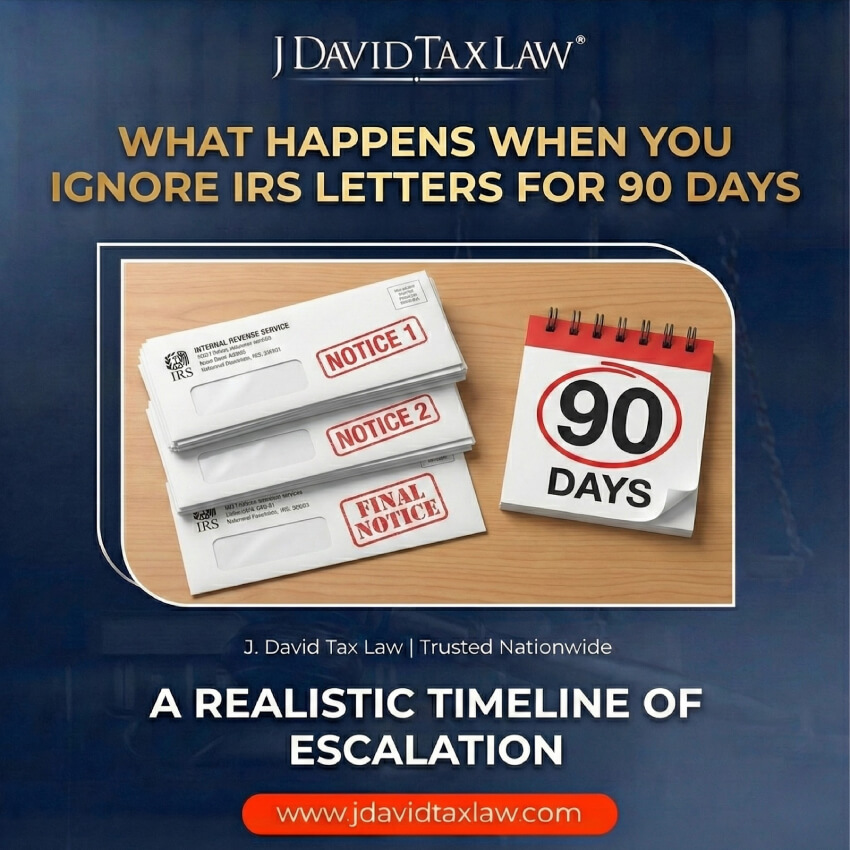
When you ignore IRS letters for 90 days, the IRS does not forget about the debt or assume you are unable to pay. Instead, the agency moves systematically through a series of collection steps that become progressively more aggressive. What begins as a simple billing notice can quickly escalate into wage garnishment, bank account levies, tax liens, and even threats of property seizure.
The IRS operates on a strict timeline. Each notice you ignore moves you closer to enforced collection, and the agency does not need your permission or a court order to seize your income and assets. By the time 90 days have passed, the IRS has typically sent multiple notices, escalated your case internally, and prepared to take direct action if you continue to ignore the debt.
Many taxpayers mistakenly believe that ignoring IRS letters will make the problem go away or that the IRS will eventually stop pursuing the debt. In reality, the opposite is true. The longer you wait to respond, the more penalties and interest accumulate, and the fewer options you have to resolve the debt on favorable terms.
This guide provides a realistic, day-by-day timeline of what happens when you ignore IRS letters for 90 days. It explains what each notice means, what actions the IRS is taking behind the scenes, and the exact point at which you lose your ability to stop enforced collection without immediate intervention.
Key Takeaways:
- Ignoring IRS letters for 90 days typically results in multiple escalating notices, increased penalties, and preparation for enforced collection.
- The IRS moves through a predictable sequence: billing notices, collection warnings, final notice, and then levies or liens.
- After 90 days, you may face wage garnishment, bank levies, or a Notice of Federal Tax Lien.
- Each ignored notice reduces your negotiating power and increases the total amount owed due to penalties and interest.
- Responding early, even if you cannot pay immediately, protects your options and prevents the most aggressive IRS actions.
- A tax attorney can stop collection at any stage, but the earlier you act, the more options remain available.
Why Taxpayers Ignore IRS Letters
Before diving into the timeline, it is important to understand why so many taxpayers ignore IRS letters in the first place. The reasons vary, but they all lead to the same outcome: escalating IRS enforcement.
Common Reasons for Ignoring IRS Notices
- Fear and anxiety: Many people are afraid to open the letters because they do not know how to handle the debt.
- Financial inability: Some taxpayers believe there is no point in responding if they cannot pay the full balance immediately.
- Confusion: IRS letters use technical language, and many taxpayers do not understand what the letter is asking them to do.
- Assumption that the IRS is wrong: Some taxpayers believe the debt is incorrect and assume the IRS will correct it on its own.
- Hope that the problem will go away: Many people mistakenly believe that ignoring the letters will make the debt disappear over time.
- Lack of awareness of consequences: Taxpayers often do not realize how quickly the IRS can move from billing to enforced collection.
None of these reasons stop the IRS from taking action. The IRS does not care why you ignored the letters, it only cares that the debt remains unpaid and that you have not responded.
The 90-Day IRS Collection Timeline
The following timeline shows what typically happens when you ignore IRS letters for 90 days. While the exact timing can vary depending on the type of tax debt and the specific IRS office handling your case, this sequence reflects the standard collection process for most individual taxpayers.
Day 0-1: IRS Assesses the Tax and Sends the First Notice
The timeline begins when the IRS assesses a tax liability against you (e.g., after filing a return showing a balance due, or after an audit).
What the IRS Does | What the Notice Says | What You Should Do | What Happens If You Ignore It |
Generates the first billing notice (typically CP14 or CP501). | “You owe [amount] in unpaid taxes.” | Read the notice and verify the amount is correct. | The IRS assumes you received the notice and prepares the next step. |
Starts calculating penalties and interest from the original due date. | “Please pay by [date] to avoid additional penalties and interest.” | If you agree, pay it in full or set up a payment plan. | Penalties and interest continue to grow daily. |
Day 14-21: Second Notice (Reminder)
If you do not respond to the first notice, the IRS sends a second reminder (typically CP501 or a similar notice).
What the IRS Does | What the Notice Says | What You Should Do | What Happens If You Ignore It |
Mails a second notice; the tone is slightly more urgent. | “We have not received payment for your tax debt.” | Pay the balance or set up an installment agreement. | The IRS escalates your case to the next notice level. |
Continues adding penalties and interest. | “If you cannot pay the full amount, contact us to discuss payment options.” | Respond to the IRS even if you need more time. | Your total balance increases due to ongoing penalties and interest. |
Day 28-35: Third Notice (Urgent Warning)
The third notice is more serious, using stronger language (typically CP503 or similar).
What the IRS Does | What the Notice Says | What You Should Do | What Happens If You Ignore It |
Mails a third notice with language warning of potential enforcement action. | “Urgent: You still owe [amount] in unpaid taxes.” | Contact the IRS immediately to set up a payment arrangement. | The IRS begins preparing to issue a Final Notice of Intent to Levy. |
Account is flagged internally as non-responsive. | “If we do not hear from you, we may take collection action, including levying your wages and bank accounts.” | Consult with a tax attorney if you cannot afford to pay. | Your case is escalated to a revenue officer or automated collection system. |
Day 42-56: Fourth Notice (Final Warning Before Levy)
This notice is often a CP504, explicitly warning that the IRS intends to levy your state tax refund and may take additional enforcement action.
What the IRS Does | What the Notice Says | What You Should Do | What Happens If You Ignore It |
Mails a CP504 or similar notice warning of state tax refund seizure. | “We intend to levy your state tax refund.” | Contact the IRS or a tax attorney immediately. | The IRS issues a Final Notice of Intent to Levy, authorizing seizure. |
Prepares to issue a Final Notice of Intent to Levy. | “We may also take other collection actions, including seizing your wages and bank accounts.” | Set up a payment plan, request CNC status, or apply for an OIC. | You lose your final opportunity to respond before enforced collection. |
Day 60-75: Final Notice of Intent to Levy
This is the most critical notice (typically Letter 1058 or LT11), sent by certified mail.
What the IRS Does | What the Notice Says | What You Should Do | What Happens If You Ignore It |
Mails the Final Notice of Intent to Levy by certified mail. | “Final Notice: We intend to levy your property and rights to property.” | File Form 12153 immediately to request a CDP Hearing and stop the levy. | After 30 days, the IRS can issue a wage garnishment, bank levy, or property seizure without additional notice. |
Gives you 30 days to request a Collection Due Process (CDP) Hearing. | “You have the right to a Collection Due Process Hearing.” | Contact a tax attorney to represent you. | You lose your right to a CDP Hearing and the right to appeal to Tax Court. |
Day 90: IRS Begins Enforced Collection
By day 90, if you have ignored all previous notices and did not file Form 12153 within the 30-day window, the IRS typically begins enforced collection.
What the IRS Can Do After Day 90
- Wage garnishment: The IRS sends a levy notice to your employer, who is required to withhold a significant portion of your paycheck (often 50% to 70% or more) and send it directly to the IRS.
- Bank levy: The IRS seizes funds from your bank account. The bank freezes the account for 21 days, then sends the money to the IRS.
- Social Security levy: The IRS can levy up to 15% of your Social Security benefits.
- Retirement account levy: The IRS can seize distributions from retirement accounts.
- Property seizure: The IRS can seize your home, vehicle, or business property and sell it at auction to satisfy the debt.
- Notice of Federal Tax Lien: The IRS files a public lien against your property, which damages your credit and makes it difficult to sell or refinance assets.
How to Stop IRS Collection After Ignoring Letters for 90 Days
Even after 90 days of ignored notices, you still have options to stop IRS collection. While your protections are weaker than they would have been if you responded earlier, you can still take action to prevent or reverse wage garnishments, bank levies, and property seizures.
Option 1: Set Up an Installment Agreement
You can request an installment agreement at any time, even after the IRS has issued a levy. Once the agreement is in place, the IRS must release wage garnishments and stop bank levies.
Option 2: Request a Levy Release Due to Economic Hardship
If the levy is causing you significant financial hardship, meaning you cannot afford food, housing, transportation, or medical care, the IRS is legally required to release the levy. You must contact the IRS and provide financial documentation showing your inability to meet basic living expenses.
Option 3: Apply for Currently Not Collectible (CNC) Status
If you cannot afford any payment toward the tax debt, you may qualify for CNC status. This temporarily pauses all IRS collection, including levies and garnishments, while you work to stabilize your finances.
Option 4: Submit an Offer in Compromise (OIC)
If you can show that paying the full balance would cause financial hardship, you can settle your tax debt for less than the full amount owed. The IRS generally pauses enforced collection while the OIC application is being reviewed.
Option 5: Hire a Tax Attorney to Negotiate on Your Behalf
A tax attorney can contact the IRS immediately, request an emergency hold on collection, and negotiate a resolution that stops the levy and protects your income. In many cases, an attorney can remove a wage garnishment in as little as 48 hours.
What Each Ignored Notice Costs You
Every IRS notice you ignore comes with a financial cost. Penalties and interest continue to grow daily, and your total debt increases even if you do not take any action.
Penalties That Accumulate When You Ignore IRS Letters
- Failure to Pay Penalty: 0.5% of the unpaid tax per month, up to 25% total.
- Interest: Calculated daily on the unpaid tax and penalties, compounded quarterly.
- Late Filing Penalty (if returns are unfiled): 5% of the unpaid tax per month, up to 25% total.
The best time to respond to an IRS notice is immediately after you receive it. The second-best time is right now.
Conclusion
Ignoring IRS letters for 90 days moves you through a predictable and aggressive collection process that ends with wage garnishment, bank levies, and property seizures. The IRS does not forget about the debt, and time does not make the problem disappear. Instead, every ignored notice increases your total debt, reduces your options, and brings you closer to enforced collection.
Even if you have ignored IRS letters for 90 days or longer, you still have options to stop collection and negotiate a resolution that protects your income and financial stability.
If you have been ignoring IRS letters or are facing a wage garnishment or bank levy, call J. David Tax Law immediately at (888) 342-9436. Our tax attorneys can stop IRS collection and negotiate a resolution that works for your situation.
Frequently Asked Questions
After 90 days of ignoring IRS letters, you typically receive a Final Notice of Intent to Levy, which gives you 30 days to respond before the IRS can seize your wages, bank accounts, and property. If you do not respond, the IRS will issue wage garnishments, bank levies, or property seizures.
Yes. Even after ignoring notices for 90 days, you can still stop a levy by setting up an installment agreement, requesting economic hardship relief, or applying for Currently Not Collectible status. If you are still within 30 days of receiving the Final Notice, you can also file Form 12153.
The IRS can take 50% to 70% or more of your paycheck through wage garnishment, depending on your filing status and number of dependents. The IRS leaves you with a small, legally exempt amount for basic living expenses and takes the rest.
Contact a tax attorney immediately to review your situation, determine which notices you received, and file the appropriate response. An attorney can stop wage garnishments, negotiate payment plans, and protect your income and assets even after weeks or months of ignored notices.