




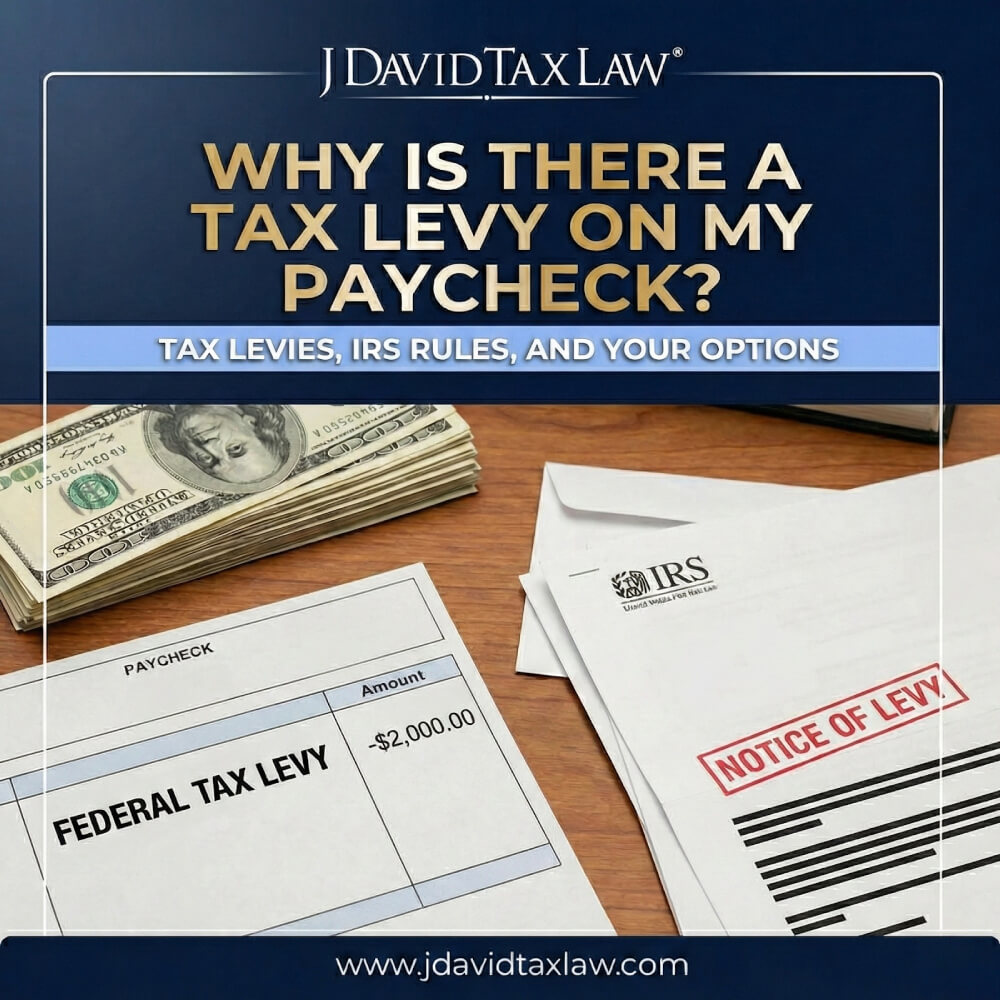
A tax levy appears on your paycheck when the IRS believes unpaid tax debt remains unresolved, a payment plan fails, required returns are missing, or a prior resolution attempt breaks down.
After the IRS completes its notice process, it can legally order your employer to send part of your wages directly to the government, without a court order. For most taxpayers, the consequences are immediate. A paycheck meant to cover rent, utilities, and food is reduced, often by far more than expected, and the levy continues each pay period until the debt is addressed or the levy is released.
Why did the IRS choose your paycheck instead of another asset? How much can it legally take, and how long can the levy last? And most importantly, what steps can stop or reverse a wage levy before it causes lasting financial damage? You’ll find out here.
What Is a Tax Levy?
A tax levy is the IRS’s legal power to seize property or income to collect unpaid taxes after required notices have been sent and ignored or unresolved. Unlike a tax bill or lien, a levy is an active collection action that results in money or assets being taken. The IRS can levy wages, bank accounts, refunds, benefits, and other property until the tax debt is satisfied or the levy is released.
Is a Levy the Same as a Tax Lien?
No. A tax lien and a tax levy are related but very different.
A tax lien is a legal claim against your property that protects the government’s interest in what you own. A tax levy is the enforcement step that comes later, allowing the IRS to actually take money or property to pay the debt.
In simple terms, a lien is a warning and a claim. A levy is the seizure.
Bank Levies Versus Wage Levies
A bank levy allows the IRS to freeze and seize funds in your bank account, usually as a one-time action based on the balance at the time of the levy. Banks are required to hold the funds for 21 days before sending them to the IRS, giving a short window to request a release.
A wage levy, often called wage garnishment, is different. It is a continuous levy that requires your employer to send a portion of each paycheck to the IRS. Unlike a bank levy, it continues pay period after pay period until the debt is resolved or the levy is lifted.
The IRS is Forgiving Millions Each Day. You Could Be Next.
Why Is There a Tax Levy on My Paycheck?
An IRS tax levy on paycheck happens when the IRS determines that voluntary resolution has failed and enforced collection is necessary. That determination is usually based on specific breakdowns in payment, compliance, or follow-through, not just the existence of tax debt.
Here are the most common reasons the IRS decides to garnish wages, and what each one means in practice:
1. Unpaid Tax Debt That Remains Unresolved
The most basic reason for a wage levy is assessed tax debt that remains unpaid after notice and demand. Once the IRS formally assesses a balance and issues a Notice and Demand for Payment, the account becomes eligible for collection if no resolution is in place.
Why this leads to a levy:
Owing taxes alone does not automatically trigger enforcement. Wage levies typically occur only after the IRS concludes that the taxpayer is not voluntarily resolving the debt, either through payment, an approved plan, or another collection alternative.
2. The IRS Chooses Wages Because Wage Levies Are Continuous
The IRS often targets paychecks because wage levies are classified as continuous levies under federal law. This allows the IRS to collect repeatedly from future earnings instead of relying on one-time asset seizures.
Why this leads to a levy:
From an enforcement perspective, wages are predictable, stable, and difficult for taxpayers to shield. When other collection methods appear unreliable, the IRS frequently escalates to wage levies.
3. The IRS Believes Exempt Income Is Still Sufficient
Federal law requires the IRS to leave a portion of wages exempt for basic living expenses, calculated using IRS tables. However, those exemptions are often limited.
Why this leads to a levy:
If the IRS determines that your remaining income exceeds the exempt threshold, it may conclude that a wage levy will not create immediate hardship, even if the reduction feels severe to you.
4. Economic Hardship Was Not Claimed or Proven in Time
The IRS must consider releasing a levy if it causes economic hardship, but hardship relief is not automatic.
Why this leads to a levy:
If hardship is not raised, documented, or approved before enforcement begins, the IRS proceeds as if collection is reasonable. Many levies occur because hardship was never formally established or was inadequately documented.
How Can We Help?
J.David Tax Law has helped clients place more than $1.3 million in tax debt into Currently Not Collectible status, stopping IRS collection and eliminating required payments. Call (888) 342-9436 to document hardship and stop IRS collection.
5. The IRS Collection Process Was Completed Without Effective Response
Before issuing a wage levy, the IRS must assess the tax, send billing notices, issue a Final Notice of Intent to Levy, and provide appeal rights.
Why this leads to a levy:
In practice, wage levies often occur not because notices were ignored, but because responses were late, incomplete, or incorrectly filed, causing appeal rights to expire.
6. Federal or State Levy Programs Escalated Collection
A state tax levy on a paycheck, also called state levy garnishment, happens when the state orders an employer to withhold part of an employee’s wages and send it directly to the state. Unlike IRS wage garnishment, which are governed by federal rules, state levy garnishment limits and procedures vary by state, and in some cases may occur simultaneously with an IRS wage levy if both debts exist.
These levies are often triggered through automated federal or state levy programs, not direct action by a revenue officer.
Key Takeaway
A wage levy does not mean the IRS suddenly targeted you. It means the IRS believes prior opportunities to resolve the debt failed or expired. In many cases, levies can still be stopped or reversed, but only after identifying which breakdown triggered enforcement and acting accordingly.
IRS Wage Levies vs State Wage Garnishment
An IRS tax levy on wage and state wage garnishment may look similar on a paycheck, but they arise under different laws and follow different rules.
What Is a State Levy Tax?
A state levy tax refers to a collection action taken by a state tax authority to recover unpaid state taxes.
State Tax Levy on a Paycheck
A state tax levy on a paycheck, also called state levy garnishment, occurs when a state orders an employer to withhold part of an employee’s wages and send it directly to the state tax agency. This is similar in function to an IRS wage levy, but the rules governing how much can be taken, how long it lasts, and what exemptions apply vary by state.
IRS Wage Levy vs State Levy Garnishment
An IRS wage levy is governed by federal law and is classified as a continuous levy, meaning it applies to wages as they are earned until the levy is released. A state levy garnishment, by contrast, is governed entirely by state statutes and administrative rules, which can change from one state to another.
Importantly, IRS and state wage garnishments can occur at the same time if both federal and state tax debts remain unresolved. This overlap often catches taxpayers off guard and significantly increases financial strain.
Why This Distinction Matters
Understanding the difference between a state wage levy and an IRS wage levy determines:
- Which laws apply
- Which exemptions are available
- Which agency must be addressed first
- Whether one action can be paused while resolving the other
Misunderstanding the difference often leads to missed deadlines and overlapping garnishments that could have been avoided.
- David Tax Law has resolved wage garnishments in as little as 48 hours in qualifying cases. Contact our tax attorneys to take immediate action.
How Long Does a Wage Levy Last?
An IRS wage levy does not have a fixed end date. Once it begins, a wage levy remains in place until the tax debt is fully paid or the levy is formally released by the IRS. Because wage levies are classified as continuous levies, they apply to each paycheck as wages are earned, not just a single pay period.
In practice, this means a wage levy can last months or even years if no action is taken. Unlike private creditor garnishments, there is no automatic expiration based on time alone.
A wage levy may be released earlier if:
- The tax debt is paid in full
- An approved payment plan or settlement is put in place
- The IRS determines the levy is causing economic hardship
- The account is placed into Currently Not Collectible status
- The statute of limitations on collection expires
It is important to understand that a levy does not stop on its own simply because time passes. Waiting often increases the total amount owed due to ongoing penalties and interest, while each paycheck continues to be reduced.
How Many Notices Does the IRS Send Before a Levy or Wage Garnishment Begins?
Before the IRS can issue a wage levy or begin wage garnishment, it must follow a structured notice process and give taxpayers multiple opportunities to respond. While the exact timeline varies, the IRS generally issues several escalating notices before enforcement action begins — and wage garnishment doesn’t start until at least 30 days after the final legal notice is mailed.
IRS Notice | Official Name | What It Means |
CP14 | Notice of Balance Due | Confirms the tax has been assessed and shows the amount owed. This is often the first notice sent after a return is processed. |
CP501 | Reminder Notice | A follow-up reminder that the balance remains unpaid and requires attention. |
CP503 | Second Reminder Notice | A more urgent notice stating the IRS has not heard from you and expects immediate action. |
CP504 | Notice of Intent to Levy | Warns that the IRS may seize assets if the balance is not resolved. Often includes intent to levy state tax refunds. |
LT11 / Letter 1058 / CP90 | Final Notice of Intent to Levy and Notice of Your Right to a Hearing | The critical legal notice. Gives at least 30 days to request a Collection Due Process hearing before wage garnishment or other levy action can begin. |
Form 668-W | Notice of Levy on Wages | Sent to your employer after the 30-day period expires. This is what legally starts wage garnishment. |
What Happens After Final Notice
Once you receive the Final Notice of Intent to Levy (often LT11, Letter 1058, or CP90), a 30-day countdown begins. If you do not pay, enter a payment agreement, or request a hearing within that period, the IRS can proceed with wage garnishment by sending a Form 668-W, Notice of Levy on Wages to your employer.
Received a final notice? Read our detailed guide on how IRS collection notices lead to wage levies and what to do next.
How Much Can the IRS Garnish From Your Paycheck?
The IRS does not use a fixed percentage when garnishing wages. Instead, it determines how much to take by allowing you a small exempt amount for basic living expenses and levying everything above that amount. This often results in a much larger portion of wages being taken compared to private creditor garnishments.
Because IRS wage levies are governed by federal law, they are not subject to the same limits that apply to state garnishments or consumer debt collections.
The amount the IRS can garnish from your paycheck is calculated using IRS Publication 1494, which sets exemption amounts based on:
- Your filing status
- How often you are paid (weekly, biweekly, monthly, etc.)
- The number of dependents you can legally claim
Your employer is required to calculate the exempt amount using these IRS tables and withhold the rest of your wages for the IRS each pay period. If you fail to return the required filing status and dependents form in time, the IRS may assume married filing separately with zero dependents, which results in the lowest possible exemption. This assumption can carry consequences similar to the penalties of filing single when married.
Bonuses, commissions, and other irregular income are not protected in the same way as regular wages. In many cases, the IRS can levy 100 percent of a bonus or commission payment because the exempt amount is already applied to your regular paycheck.
This frequently surprises employees in sales, management, or performance-based roles, who assume bonuses will be partially protected. Under IRS rules, once the exemption has been applied to your normal wages, additional compensation may be taken in full.
How Do I Stop an IRS Tax Levy or Wage Garnishment on a Paycheck?
Stopping an IRS tax levy or wage garnishment depends on where your account is in the IRS collection process. Even after garnishment begins, the IRS allows several legal paths to pause, release, or restructure the levy — but timing and documentation matter.
If wages are already being garnished, the first priority is to halt ongoing collection. This often requires direct communication with the IRS and formal submission of the correct forms. In many cases, collection can be paused once the IRS confirms that a valid resolution request is under review.
The IRS may release or reduce a wage levy if:
- The levy is causing economic hardship
- A payment plan or settlement is approved
- The tax debt is paid or legally resolved
- The account qualifies for Currently Not Collectible status
Hardship claims must be documented with detailed financial information. Informal explanations are rarely sufficient.
Establishing an approved installment agreement or Offer in Compromise typically results in the release of a wage levy. The IRS requires that all required tax returns be filed before approving most arrangements, and proposed payments must align with documented financial capacity.
If the levy was issued recently or proper notice requirements were not met, you may have the right to appeal the levy through a Collection Due Process hearing or equivalent hearing. Appeals can temporarily stop collection while the matter is reviewed.
Wage garnishment does not stop on its own. Waiting often results in continued withholding, additional penalties, and lost appeal rights. The sooner the issue is addressed, the more options typically remain available.
Key takeaway
Stopping an IRS wage levy is possible, even after it starts, but only when the correct procedural steps are taken and supported with proper documentation. Set up a free consultation with our tax experts, If you have tax levy on your paycheck
What Happens After a Wage Levy Is Released?
When an IRS wage levy is released, your employer is notified to stop withholding wages for the IRS, and your regular paycheck resumes going forward. The release applies prospectively, meaning future wages are no longer garnished, but amounts already taken are generally not refunded unless the levy was issued in error.
Other Types of IRS Tax Levies
While wage and bank levies are the most common, the IRS has authority to levy many other types of income and property depending on the taxpayer’s situation.
An accounts receivable levy allows the IRS to seize money owed to you by customers or clients. Instead of paying your business, those third parties are legally required to redirect payments to the IRS. This type of levy can disrupt cash flow and damage business relationships.
Under refund offset programs, the IRS may keep your federal tax refund and apply it to outstanding tax debt. Through the State Income Tax Levy Program, the IRS may also intercept state tax refunds until the balance is reduced or resolved.
Through the Federal Payment Levy Program, the IRS may levy up to 15 percent of certain federal payments, including Social Security benefits. These levies are ongoing and continue until the debt is resolved or the levy is released.
The IRS may levy IRAs and certain retirement accounts if the funds are accessible under the terms of the plan. If the taxpayer has the legal right to withdraw funds, the IRS generally has the right to levy those funds as well.
Payments owed to federal contractors may be subject to levy, sometimes through expedited or automated processes. In certain situations, these levies may occur with fewer procedural protections than standard wage levies.
In extreme cases, the IRS may seize vehicles, business equipment, or real property to satisfy unpaid tax debt. Physical asset seizures are uncommon and typically reserved for cases involving prolonged noncompliance or significant tax liabilities.
Conclusion
An IRS wage levy can take more from your paycheck than most people expect and can continue until the tax issue is properly resolved. The IRS does not use a fixed percentage, relies on limited exemption tables, and can garnish wages for months or even years if no action is taken. The good news is that wage levies can often be stopped, reduced, or released when the correct procedural steps are followed and supported with proper documentation. The outcome depends on timing, compliance, and choosing the right resolution path. Taking action early is the most effective way to protect your income and avoid further financial damage.
Frequently Asked Questions
A tax levy is one of the IRS’s most serious enforcement actions because it allows the government to take your wages, bank funds, or other assets directly. Once a levy begins, it continues until the debt is resolved or the IRS formally releases it.
An IRS tax levy can be stopped by paying the debt, entering an approved payment plan or settlement, proving economic hardship, or successfully appealing the levy. The correct option depends on where your account is in the IRS collection process and how quickly action is taken.
No. A tax levy is the IRS’s legal authority to seize property, while wage garnishment is one type of levy that applies specifically to paychecks. In short, garnishment is how a wage levy is carried out.
A tax levy appears on your paycheck when the IRS believes prior attempts to resolve unpaid taxes failed and enforced collection is necessary. This typically happens after required notices are sent and response deadlines pass.
In most cases, no. The IRS must first assess the tax, send multiple notices, and issue a Final Notice of Intent to Levy with at least 30 days to respond before garnishing wages. Limited exceptions exist in rare situations, such as jeopardy levies or certain federal contractor cases.
You should contact a qualified tax attorney like J. David Tax Law or tax resolution professional who handles IRS collection matters. A tax attorney can review your account status, communicate directly with the IRS on your behalf, and take steps to stop or release the levy when possible.
Normally, taxes taken out of a paycheck include federal income tax, Social Security, Medicare, and any applicable state taxes based on your withholding elections. Wage garnishment is different and only happens when you have unpaid tax debt with the IRS or a state tax authority, allowing them to take additional money from your paycheck through a tax levy.