




Last updated on January 2nd, 2026 at 12:52 pm
IRS Form 12153 is the official document you file to request a Collection Due Process (CDP) Hearing, a legal procedure that halts IRS collection actions, including levies, garnishments, and property seizures, while your case is reviewed by the IRS Independent Office of Appeals.
When you submit Form 12153 within 30 days of receiving a Final Notice of Intent to Levy or a Notice of Federal Tax Lien, the IRS must suspend enforced collection until the hearing is complete. This gives you the opportunity to challenge the IRS’s actions, dispute the amount owed, propose a payment plan or settlement, or request relief such as penalty abatement or innocent spouse relief.
Key Takeaways
- Form 12153 lets you request a CDP Hearing and pause IRS levies and garnishments while your case is reviewed.
- You must file within 30 days of receiving a Final Notice of Intent to Levy or a Notice of Federal Tax Lien.
- A CDP Hearing allows you to dispute the tax, request relief, or propose a resolution such as a payment plan or settlement.
- Missing the 30-day deadline means you can still request an Equivalent Hearing, but it won’t stop collection or allow a Tax Court appeal.
- The Appeals Officer issues a Notice of Determination with the final decision, which can be appealed to the Tax Court if filed on time.
- A tax attorney can help protect your rights and may remove wage garnishments in as little as 48 hours.
IRS Form 12153: Request for a Collection Due Process or Equivalent Hearing
When the IRS sends a Final Notice of Intent to Levy or files a Notice of Federal Tax Lien, your time to respond is limited. One of the strongest legal tools available to protect your rights is IRS Form 12153, the official request for a Collection Due Process (CDP) Hearing or Equivalent Hearing. Filing this form, correctly and on time,can stop an IRS levy before it starts, prevent asset seizure, and give you the opportunity to challenge IRS actions or negotiate a tax resolution.
What Is Form 12153?
Form 12153 is the IRS form a taxpayer must file to request a Collection Due Process (CDP) Hearing or an Equivalent Hearing after receiving a qualifying IRS notice. By filing Form 12153, you activate legal protections that require the IRS to:
- Pause most collection actions, including levies and garnishments
- Review your case through the Independent Office of Appeals
- Consider alternatives, such as an installment agreement, Offer in Compromise, or penalty relief
- Verify that all IRS procedures were followed correctly
The IRS is Forgiving Millions Each Day. You Could Be Next.
What Is a Tax Lien Versus a Tax Levy?
A tax lien and a tax levy are two very different IRS enforcement tools, and understanding the difference is essential when deciding how and when to use Form 12153.
Tax Lien
A tax lien is the government’s legal claim against your property when you owe a tax debt. It does not take your assets. Instead, it secures the IRS’s interest in everything you own, including:
- Real estate
- Vehicles
- Business assets
- Future property you acquire
The IRS typically files a Notice of Federal Tax Lien to alert creditors and impact your ability to borrow or sell property. While a lien does not seize anything by itself, it can disrupt financing, credit, and property transfers.
Tax Levy
A tax levy is the actual seizure of your property to satisfy a tax debt. This can include:
- Bank account levies
- Wage garnishments
- Seizure of physical property
- Seizure of Social Security benefits
- Seizure of accounts receivable or business income
If your wages or bank account are already being hit, our tax attorneys can remove an IRS wage garnishment in as little as 48 hours. Call us before the IRS takes more from you.
What Is a Collection Due Process Hearing?
A Collection Due Process (CDP) Hearing is a formal appeal with the IRS Independent Office of Appeals that gives taxpayers the opportunity to challenge IRS collection actions before the IRS moves forward with levies, garnishments, or property seizures. When you file IRS Form 12153 on time, you secure the right to this hearing and trigger an immediate pause on most enforced collection.
During a CDP hearing, an Appeals Officer—who is required to be independent from IRS Collections—reviews your case to ensure:
- The IRS followed all legal and procedural requirements
- You received proper notice of the IRS’s intended actions
- Your financial circumstances and proposed alternatives are fully considered
- The planned collection action is no more intrusive than necessary
- Your rights as a taxpayer have been respected
A CDP hearing is typically conducted by phone or video conference, and it allows you to present evidence, propose a payment agreement, dispute the amount owed, request penalty relief, or raise defenses such as innocent spouse relief. Because the hearing is appealable to Tax Court if you disagree with the outcome, it provides far stronger protection than most other IRS appeal options.
Why Request a Collection Due Process Hearing?
A CDP hearing allows you to:
- Stop or prevent an IRS levy before your wages, bank accounts, or assets are seized
- Challenge the IRS’s actions if you believe they were premature or improperly initiated
- Dispute the underlying tax liability in certain situations
- Propose alternatives such as an installment agreement or Offer in Compromise
- Request penalty abatement when appropriate
- Raise defenses, including innocent spouse relief
- Protect your right to judicial review by preserving the option to appeal to the U.S. Tax Court
Below are two of the most common reasons taxpayers request a CDP hearing.
Appealing Your Tax Liability Due
If you never received a prior opportunity to dispute the amount the IRS says you owe, a CDP hearing may allow you to challenge the underlying tax liability. This can include situations where:
- The IRS made an assessment without your knowledge
- The amount owed includes penalties that were improperly applied
- You believe the IRS miscalculated your tax debt
- You disagree with audit findings that you didn’t previously appeal
This is one of the few settings in which the IRS must pause collection and formally reconsider the tax amount itself. Not sure how much you owe? Use our IRS Penalty Calculator to get a fast estimate of what the IRS may be adding to your balance.
Resolving Your Tax Liability Through Payments or a Settlement
A CDP hearing gives you the opportunity to negotiate a manageable solution, such as:
- A monthly installment agreement
- A partial payment installment agreement
- An Offer in Compromise
- Currently Not Collectible (CNC) status
- Penalty abatement
The Appeals Officer must evaluate whether your proposed resolution is more appropriate and less intrusive than the IRS’s intended levy.
For many taxpayers, this hearing is the turning point that makes long-term relief possible.
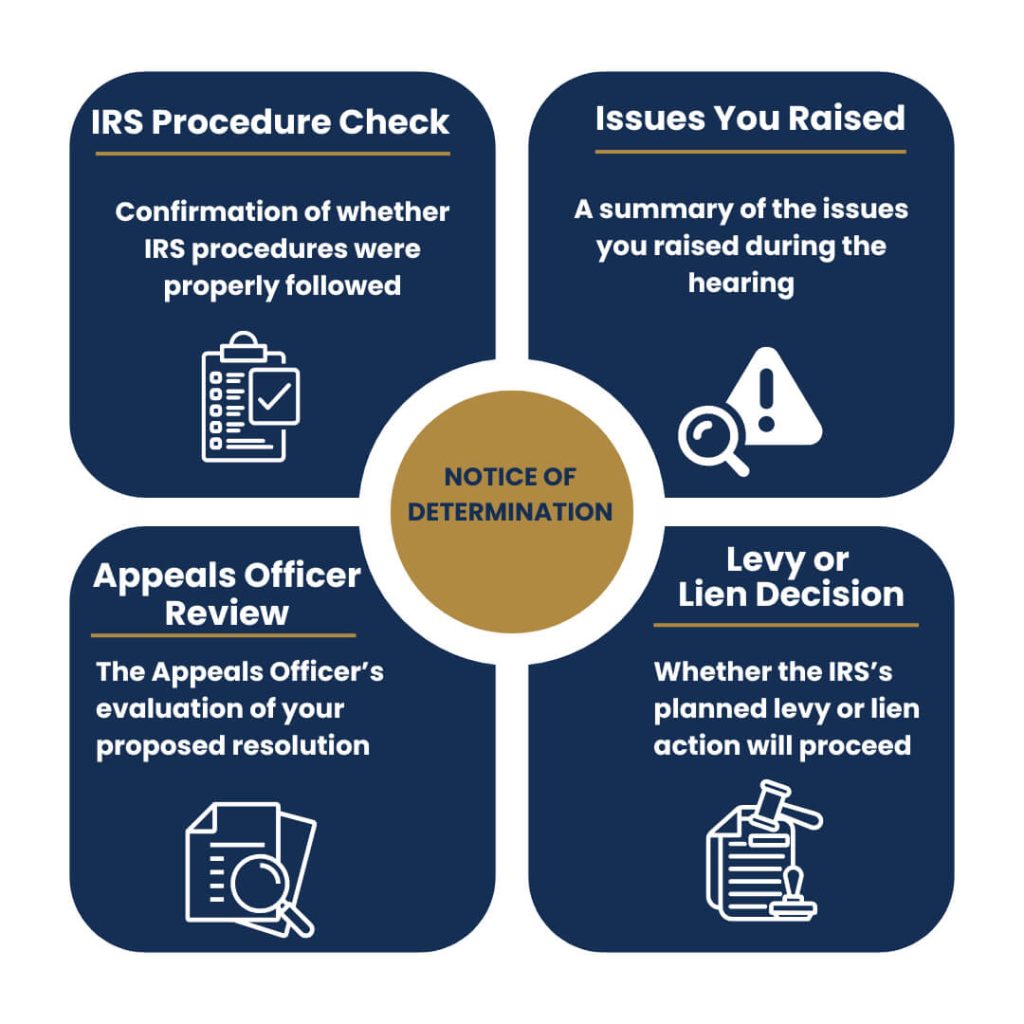
Notice of Determination
A Notice of Determination is the formal written decision you receive from the IRS Independent Office of Appeals after your Collection Due Process (CDP) hearing. This document outlines the Appeals Officer’s findings, the resolution they approved or denied, and the reasons behind their decision.
When Should You Request a Collection Due Process Hearing?
You should request a Collection Due Process (CDP) Hearing as soon as you receive a qualifying IRS notice that warns of enforced collection. The most common notices that trigger your right to file Form 12153 include:
- Final Notice of Intent to Levy
- Notice of Federal Tax Lien
- Notice of Jeopardy Levy or Jeopardy Lien
- Notice of Levy on Your State Tax Refund
How Do You Request a Collection Due Process Hearing?
Requesting a Collection Due Process (CDP) hearing begins with completing and submitting IRS Form 12153. The process is straightforward, but accuracy and timing are critical for protecting your rights and stopping enforced collection.

1. Confirm You Received a Qualifying IRS Notice
You must receive one of the following before you’re eligible to file Form 12153:
- Final Notice of Intent to Levy
- Notice of Federal Tax Lien
- Notice of Levy on Your State Tax Refund
- Post–Assessment Notice informing you of CDP rights
The notice will clearly state your right to request a CDP hearing.
2. Complete IRS Form 12153
Fill out the form with:
- Your personal information
- The tax years in question
- The type of IRS action you’re appealing
- The resolution you are requesting
You may also attach supporting financial documents or statements that help build your case.
3. Mail the Form to the Correct IRS Address
Form 12153 must be mailed to the address shown on the IRS notice you received. Sending it anywhere else may delay processing or result in loss of appeal rights.
4. Keep Proof of Mailing
Always send the form by certified mail or another trackable method. The IRS honors the postmark date, which can protect you even if the IRS receives the form after the 30-day deadline.
Once the form is submitted, the IRS must pause most enforced collection while your request is reviewed and your case moves to the Independent Office of Appeals.
Which Documents Should You Include With Form 12153?
While Form 12153 can be submitted on its own, including the right supporting documents strengthens your case and helps the IRS Appeals Officer understand your financial situation and the resolution you are requesting. Depending on your circumstance, you may want to include:
1. A Copy of the IRS Notice You Are Appealing
Attach the notice that triggered your CDP rights—such as a Final Notice of Intent to Levy or a Notice of Federal Tax Lien. This confirms your eligibility and ensures proper case routing.
2. Recent Financial Information
If you are requesting a payment plan, settlement, or Currently Not Collectible status, Appeals may need financial documentation. Examples include:
- Recent pay stubs
- Bank statements
- Profit and loss statements (if self-employed)
- Mortgage or rent statements
- Utility bills and essential living expense documentation
3. A Written Statement Explaining Your Position
A short explanation strengthens your request. You can clarify:
- Why the IRS’s action is inappropriate or premature
- Why you believe the amount owed is incorrect
The alternative resolution you are proposing
4. Forms Related to Your Proposed Resolution
If applicable, include:
- Form 433-A or 433-F (collection information statements)
- Form 656 (Offer in Compromise package)
- Innocent spouse relief forms (Form 8857)
- Penalty abatement request documents
5. Any Supporting Evidence
Depending on your claim, this may include:
- Medical hardship documentation
- Divorce or separation records
- Letters from employers or lenders
- Proof of identity theft or fraud
Submitting full documentation helps Appeals review your case more efficiently and increases the likelihood of a favorable outcome.
How to Fill in Form 12153?
Form 12153 is straightforward, but completing it accurately is essential for protecting your rights and securing a pause on IRS collection. Each section of the form serves a specific purpose and gives the IRS the information needed to route your case properly and understand the resolution you are requesting.
Your Information
In this section, you provide basic identifying details, including:
- Your name and contact information
- Your Social Security Number or Employer Identification Number
- Your spouse’s information if the tax issue involves a joint return
- The best way for Appeals to contact you
Make sure this information is accurate, as any errors can delay your hearing or cause miscommunication with the IRS.
Your Appeal
Here, you identify the IRS action you are disputing and the tax periods involved. You also explain the reason for your appeal, such as:
- Challenging the amount owed
- Disputing the IRS’s intended levy or lien
- Requesting a different collection alternative
You may attach a separate statement if you need more space to explain your position.
If You Are Unable to Pay
If your appeal involves financial hardship or an inability to pay your full balance, you should indicate the type of resolution you are seeking, such as a monthly installment agreement, Currently Not Collectible status or an Offer in Compromise. The IRS may require financial documents, such as Form 433-A or 433-F, to support your request.
Innocent Spouse Release
If you believe you should not be held responsible for a tax debt related to a spouse or former spouse, you can use this section to request consideration of innocent spouse relief, separation of liability, or equitable relief. You may need to provide Form 8857 and supporting documentation.
Need help completing Form 12153? Our tax attorneys can prepare and submit a Form for you, Call (888) 342-9436 for immediate assistance.
Where to Send Form 12153
You must mail Form 12153 to the IRS address printed on the notice you received, such as the Final Notice of Intent to Levy or the Notice of Federal Tax Lien. Always mail the form using certified mail or another trackable service and keep proof of mailing, because the IRS uses the postmark date to determine whether your request was filed on time.
What If You Miss the 30-Day Deadline to Request a CDP Hearing?
If you miss the 30-day deadline, you no longer qualify for a full Collection Due Process hearing, but you can still request an Equivalent Hearing by submitting Form 12153 within one year of the date on your notice. An Equivalent Hearing gives you an Appeals review and allows you to propose alternatives such as a payment plan, settlement, or penalty relief, but it does not stop IRS collection actions and does not give you the right to petition the U.S. Tax Court if you disagree with the result. Even though your protections are more limited, an Equivalent Hearing can still be valuable if you need time to work with Appeals, correct errors, or negotiate a resolution before enforced collection becomes more aggressive.
CDP Hearing vs. Equivalent Hearing
Feature | CDP Hearing | Equivalent Hearing |
Purpose | Stop an IRS levy and fully challenge IRS actions | Get an Appeals review after missing the 30-day deadline |
Filing Deadline | 30 days from IRS notice | 1 year from IRS notice |
Stops IRS Levy / Garnishment | Yes, collection pauses | No, collection continues |
Right to Go to Tax Court | Yes | No |
Independent Appeals Review | Yes | Yes |
Strength of Protection | Strongest IRS appeal protection available | Moderate protection, mainly for review |
Conclusion
IRS Form 12153 is one of the most powerful tools taxpayers have to stop an IRS levy and ensure that their case is reviewed fairly. Filing this form on time gives you immediate protection from enforced collection, preserves your right to challenge the IRS’s actions, and opens the door to solutions such as payment plans, penalty relief, innocent spouse relief, settlement options, or hardship status.
If the IRS is threatening to levy your wages or bank account, J. David Tax Law can help. Call us at (888) 342-9436 for a free, confidential consultation today.
Frequently Asked Questions
Form 12153 is the IRS form you file to request a Collection Due Process (CDP) Hearing, which can pause levies and other enforced collection while your case is reviewed. It allows you to challenge IRS actions, dispute the balance, or request relief such as a payment plan or settlement.
You must mail Form 12153 to the IRS address printed on the notice you received, such as a Final Notice of Intent to Levy or a Notice of Federal Tax Lien. Always send it by certified mail or another trackable service so you have proof of timely filing.
Currently Not Collectible (CNC) is a temporary status the IRS grants when you cannot afford to pay your tax debt without causing financial hardship. While in CNC, the IRS pauses levies and garnishments, though penalties and interest may continue to accrue.
No — a CP504 notice does not give you the right to request a Collection Due Process (CDP) hearing. Your CDP rights are triggered only when you receive a Final Notice of Intent to Levy (LT11 or Letter 1058) or a Notice of Federal Tax Lien, not a CP504.
Yes, you have the right to be represented by a licensed tax attorney during a Collection Due Process (CDP) hearing. Having an attorney handle the hearing can strengthen your case, protect your rights, and improve your chances of securing a favorable resolution. Talk to our tax attorney today!