





Last updated on December 17th, 2025 at 05:11 am
Did you know a simple mistake on your tax return could cost you thousands in penalties? Late filing, missed payments, or payroll deposit errors add up quickly, but the IRS does offer ways to reduce or remove these charges.
IRS First Time Penalty Abatement (FTA) is a one-time relief program that allows eligible taxpayers to remove penalties such as Failure-to-File, Failure-to-Pay, or Failure-to-Deposit if they have a clean compliance history. Backed by IRS Policy Statement 3-2, FTA is one of several penalty relief options available to taxpayers.
For those who don’t qualify, the IRS may grant relief under Reasonable Cause if circumstances beyond your control — like illness, natural disaster, or lack of access to records — prevented you from complying. Together, these programs can significantly reduce your tax burden and help you get back on track.
Key Takeaways
- First Time Penalty Abatement (FTA) is a one-time IRS program that removes penalties for Failure-to-File, Failure-to-Pay, and Failure-to-Deposit if you have a clean compliance history.
- To qualify, taxpayers must have no penalties in the past 3 years, all required returns filed, and taxes paid or on a payment plan.
- IRS Policy Statement 3-2 is the foundation of FTA, ensuring penalties encourage compliance rather than punish one-time mistakes.
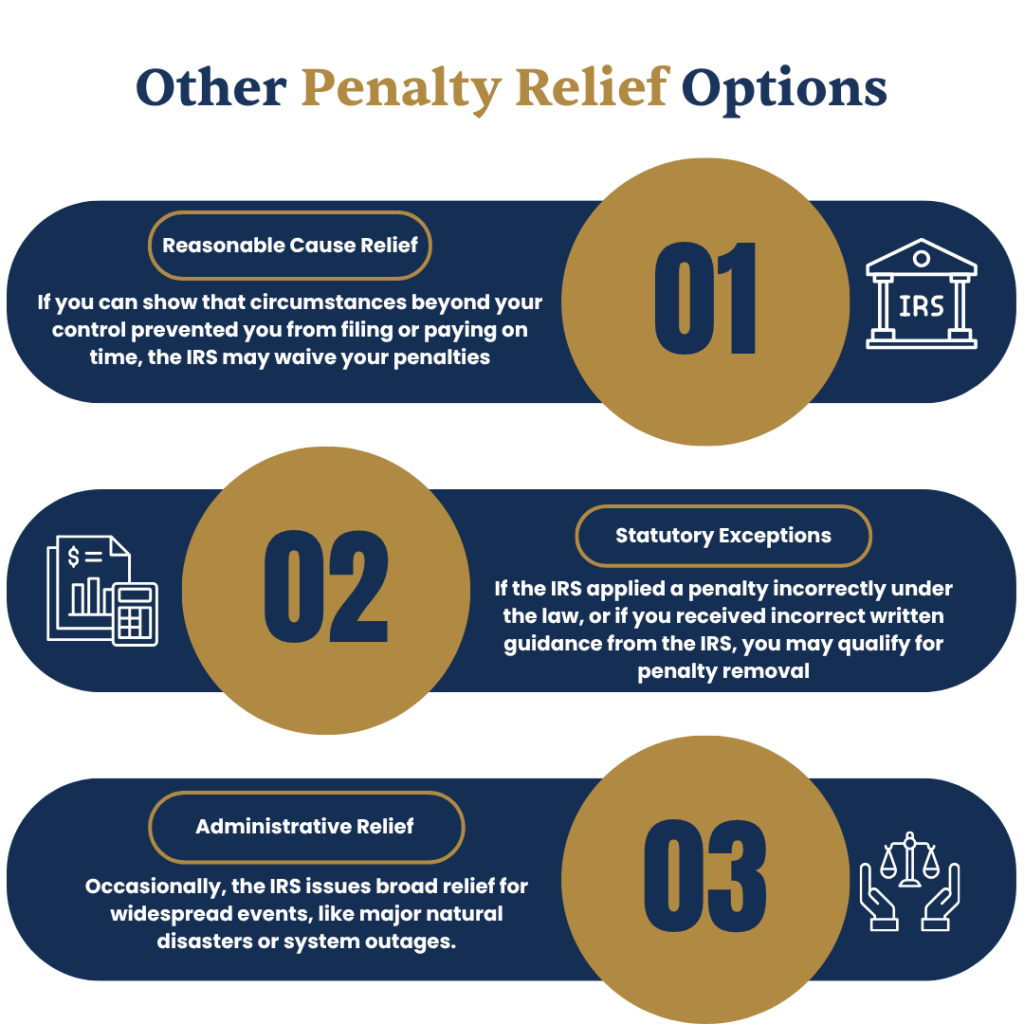
- If you don’t qualify for FTA, other options include Reasonable Cause Relief or Statutory Exceptions.
- Working with a tax attorney improves approval chances and helps manage IRS requests.
What Penalties Can Be Removed with IRS First Time Penalty Abatement?
The First Time Abatement program applies to three common types of penalties : Failure-to-File, Failure-to-Pay, and Failure-to-Deposit. These rules impact both individuals and businesses, including S Corporations and Partnerships. Below is a breakdown of how they work and how FTA (or other relief) can help.
Failure-to-File Penalty
Failure to File Penalties are applied when individuals or businesses don’t submit their required tax returns on time.
Eligibility for Failure to file Penalty Relief
You may be eligible for this penalty relief if you can show reasonable cause i.e,. that you exercised ordinary care and were still unable to file your tax return or pay taxes on time. Some valid reasons for failure to file or failure to pay penalties may include:
- Natural disasters, fires, or civil disturbances
- Inability to obtain records
- Death, serious illness, or unavoidable absence of the taxpayer or their immediate family
- System issues that prevented timely electronic filing or payment
For more details, refer to Policy Statement 3-2.
The IRS is Forgiving Millions Each Day. You Could Be Next.
Here’s a breakdown of how these penalties work:
If you don’t file your personal tax return on time, IRC Section 6651(a)(1) will apply. This includes penalties for income tax returns and other required filings. The penalty grows based on how late the return is.
- If you don’t file your tax return by the due date, the IRS imposes a penalty. This penalty is 5% of the tax owed for each month (or part of a month) the return is late, up to a maximum of 25%.
- If the return is more than 60 days late, the penalty will be at least $435 or 100% of the unpaid tax, whichever is less.
- You can avoid this penalty if you can prove the failure was due to reasonable cause and not due to willful neglect.
If the failure to file is due to fraud, the penalty is much higher: 15% per month, up to 75% of the unpaid tax.
Partnerships are required to file returns under IRC Section 6698(a)(1). If they don’t file on time, they will face penalties. This section covers partnership returns that are late or incomplete. If a partnership fails to file the required tax return or partnership adjustment tracking report on time, or if the return is incomplete, the partnership will be subject to a penalty. This penalty applies for each month the failure continues, up to a maximum of 12 months, unless the failure was due to a reasonable cause. The penalty is calculated based on the number of partners and applies until the required documents are properly filed.
S Corporations must file their returns as outlined in IRC Section 6699(a)(1). If an S corporation fails to file its required tax return on time or submits an incomplete return, the corporation will be subject to a penalty. This penalty applies for each month (or part of a month) the failure continues, up to a maximum of 12 months. The penalty continues to accrue unless the S corporation can demonstrate that the failure was due to a reasonable cause. This penalty is in addition to any other penalties related to willful failure to file or pay taxes under section 7203.
Frustrated by ongoing tax penalties? Our tax attorneys can help you reduce or remove penalties for individual, partnership, and S Corporation returns—Contact us today!
Failure-to-Pay Penalty
Failure to pay penalties apply when a taxpayer does not pay the tax owed by the due date. If the amount shown on the return is not paid on time, penalties can accumulate monthly. In addition, if tax is owed but not shown on the return and not paid by the date specified in an IRS notice or demand, further penalties may be imposed.
Eligibility for IRS Failure to Pay Penalty Relief
The eligibility criteria for Failure-to-Pay penalty relief are similar to those for Failure-to-File. Both require demonstrating a history of compliance and/or showing reasonable cause for the delay in payment or filing.
This penalty is a percentage of the unpaid taxes and will not exceed 25% of your total unpaid taxes. Here’s an overview of how the Failure to Pay penalty is determined based on the type of unpaid tax and the duration it remains outstanding.
The IRS is Forgiving Millions Each Day. You Could Be Next.
How the IRS Calculates the Failure-to-Pay Penalty
The IRS charges a Failure-to-Pay penalty when taxes are not paid by the due date. The penalty can apply in two situations:
If you fail to pay the amount shown on your tax return, the Failure to Pay penalty is calculated as follows:
- 0.5% of unpaid taxes per month, capped at 25%.
- If both Failure-to-Pay and Failure-to-File apply in the same month, the IRS reduces the Failure-to-File penalty accordingly (e.g., 4.5% + 0.5%).
- With an approved IRS payment plan and timely filing, the penalty drops to 0.25% per month.
- If unpaid within 10 days of receiving an intent to levy notice, the penalty increases to 1% per month.
If the IRS determines you owe additional tax that you did not report on your return, the Failure to Pay penalty is calculated based on the following:
- The IRS issues a notice of additional tax due with a deadline (21 days, or 10 business days if over $100,000).
- If unpaid by the due date, penalty is 0.5% per month, up to 25%.
- Reduced to 0.25% per month if on an IRS payment plan and filed on time.
- If unpaid within 10 days of an intent to levy notice, the penalty rises to 1% per month.
Learn How a Tax Attorney Can File a Strong Request for First Time Penalty Abatement. Call us at (888) 342-9436 to secure your first IRS abate
Failure-to-Deposit Penalty
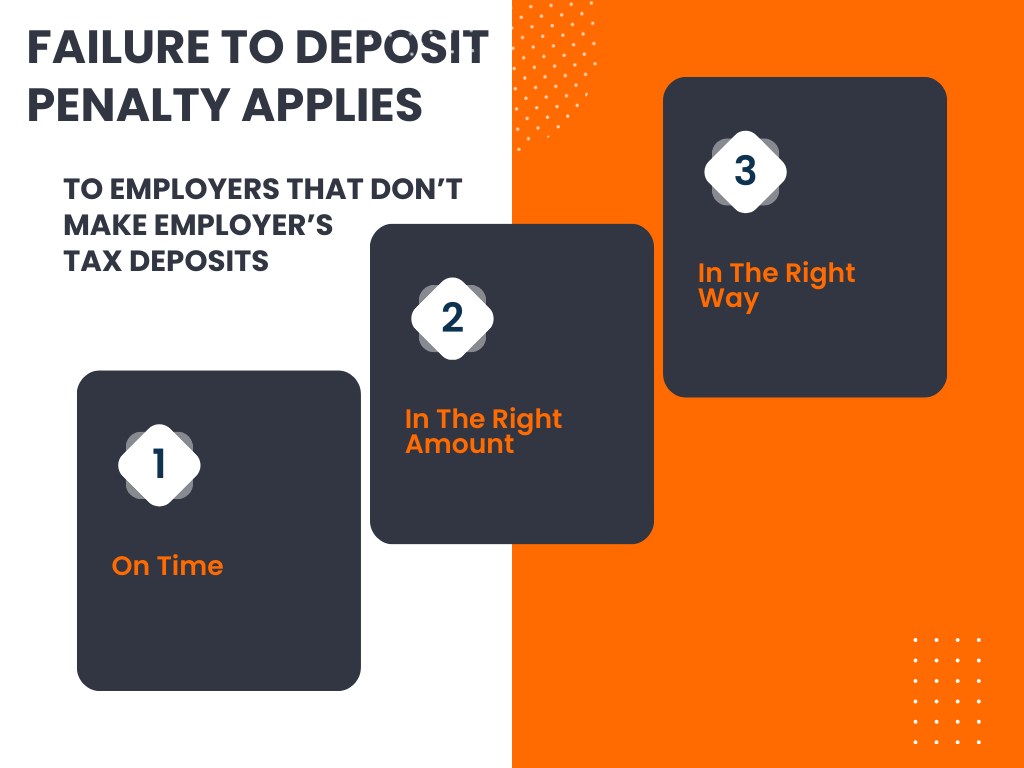
The Failure to Deposit penalty applies when employment taxes are not deposited correctly by the employers. This can happen if the tax amount is incorrect, if the deposit was made after the prescribed deadline, or if the deposit wasn’t made in the required manner.
Under IRC 6656, penalties may be imposed if any of these conditions are not met, leading to additional charges based on how late or incomplete the deposit is. Employer-paid taxes include federal income tax, Social Security and Medicare taxes and Federal Unemployment Tax. Employers must send employment tax deposits to the IRS on a monthly or semi-weekly schedule.
Eligibility for Failure-to-Deposit Penalty
- The IRS may waive the penalty for first-time depositors of employment taxes if the failure was inadvertent and the return was filed on time.
- The IRS may abate the penalty if the depositor mistakenly sent the payment to the wrong place but was otherwise compliant and had a reasonable cause for the error
Calculation of Penalty
The penalty is calculated based on the length of the delay:
- 2% if the failure is for not more than 5 days,
- 5% for 6-15 days,
- 10% for over 15 days.
If the deposit isn’t made within 10 days after the first delinquency notice or after a demand for immediate payment, the penalty increases to 15%.
Did you know Ryan’s case was a challenge, but J. David Tax Law didn’t give up. After three attempts, we secured a full waiver of $150,888 in penalties and interest.
IRS Penalties Eligible for First Time Penalty Abatement
Penalty Type | Who It Applies To | What Triggers the Penalty | Eligible for FTA? |
Failure to File (FTF) | Individuals, Partnerships, S Corporations | Filing a required tax return after the due date or extension | Yes |
Failure to Pay (FTP) | Individuals & Businesses | Not paying the tax owed by the due date | Yes |
Failure to Deposit (FTD) | Employers with payroll tax obligations | Not depositing federal employment taxes accurately or on time | Yes |
What If You Don’t Qualify for First Time Penalty Abatement?
Not everyone will meet the IRS’s strict eligibility requirements for First Time Penalty Abatement but the good news is that other relief options are still available:
How a Tax Attorney at J David Tax Law Can Help
We specialize in offering personalized legal support to help you secure the penalty relief you need. Our experienced tax attorneys work closely with you to understand IRS regulations, ensuring you meet the qualifications for First-Time Penalty Abatement. Here’s how we guide you through the process:
Our tax attorneys will carefully assess your compliance history to determine whether you meet the IRS’s First-Time Penalty Abatement eligibility criteria. We’ll verify if you’ve had any penalties in the last three years or if any penalties were previously removed for valid reasons.
We’ll confirm that all your required tax returns have been filed with the IRS. Missing or unfiled returns can disqualify you from FTA relief, so our tax relief attorneys work to ensure everything is up to date before proceeding.
If you have unpaid taxes, we’ll help you settle those through payment or set up an IRS-approved payment plan. Having a payment plan in place is key to qualifying for First-Time Penalty Abatement, and our attorneys will ensure you’re on the right track.
Once eligibility is confirmed, our tax attorneys will submit a strong FTA request on your behalf, ensuring all documentation and compliance are in order to maximize the chances of penalty relief.
In case your FTA request is denied or additional issues arise, we’ll help you explore other relief options, including reasonable cause appeals or other IRS programs to reduce your financial burden.
Our tax specialists at J David Tax Law are committed to helping you secure the First-Time Penalty Abatement you deserve. Get a free consultation today and see how much you can save on penalties!
Conclusion
IRS penalties can feel overwhelming, but relief is often within reach. Whether you qualify for First Time Penalty Abatement or need to pursue Reasonable Cause or another relief option, the right strategy can save you thousands of dollars. With experienced legal guidance, you can stop penalties from growing, restore compliance, and move forward with confidence.
Other Related Resources:
Federal back tax abatement program: The Taxpayer’s Guide
Top 5 Reasons the IRS Denies Penalty Abatement Requests
Avoid the IRS Failure to Pay Penalty – 5 Ways to Fix Your Unpaid Taxes Fast
How to Get the IRS to Waive Tax Penalties
What is considered tax evasion? Red Flags and Penalties You Should Know
Frequently Asked Questions
First Time Penalty Abatement (FTA) is a one-time IRS relief program that allows eligible taxpayers to remove certain penalties, including Failure-to-File, Failure-to-Pay, and Failure-to-Deposit. To qualify, you must have a clean compliance history for the past three years, have filed all required returns, and be current on taxes owed or on an IRS-approved payment plan.
A good reasonable cause is any situation where circumstances beyond your control made it impossible to file or pay on time. The IRS commonly accepts reasons such as serious illness, natural disasters, inability to access essential records, or reliance on incorrect advice from the IRS. To succeed, you must show that you acted responsibly once the issue was resolved and provide documentation to support your claim.
Many taxpayers start by calling the IRS, but phone calls rarely result in a full penalty removal. The IRS usually requires a formal written request, often through Form 843 (Claim for Refund and Request for Abatement), supported by proof that you qualify. Approval depends on meeting the criteria for First Time Abatement or showing Reasonable Cause with documentation. Because many self-filed requests are denied, having a tax attorney handle the process greatly increases the likelihood of success.
IRS Policy Statement 3-2 is the official guideline that allows the IRS to grant penalty relief. Its purpose is to promote voluntary compliance, not to punish taxpayers for one-time mistakes. Under this policy, the IRS may remove penalties for taxpayers with a clean compliance history through programs like First Time Penalty Abatement (FTA) or Reasonable Cause Relief.
A tax attorney evaluates your compliance history, compiles necessary documentation, and submits the IRS First-Time Penalty Abatement request on your behalf. They also communicate directly with the IRS to address inquiries and follow up on your case. Our A+ rated tax law firm can manage every step, giving you the highest chance of securing penalty relief.