




Last updated on January 9th, 2026 at 06:32 am
Each year, the IRS assesses tens of billions of dollars in civil penalties, and only a portion of those are ever removed. For common failure to file and failure to pay penalties, only about 12% are ultimately abated, which means most taxpayers either never ask for relief or do not present a strong enough case for the IRS to approve it.
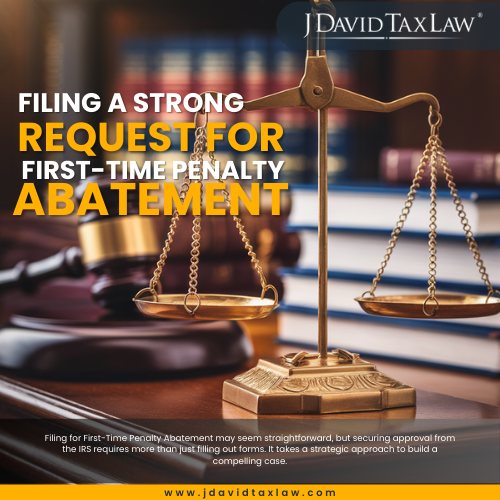
Securing First Time Penalty Abatement from the IRS is not as simple as submitting Form 843 or requesting relief by phone. The IRS reviews every abatement request with strict scrutiny, and even a small oversight in documentation, compliance history, or the explanation you provide can result in a denial. The strength of your request matters as much as your eligibility.
This is where an IRS penalty abatement attorney becomes essential. A tax attorney does more than complete forms. They examine your full compliance history, identify weaknesses that could trigger an immediate rejection, prepare the supporting documents the IRS expects to see, and draft a compelling narrative that clearly shows why you qualify for First Time Penalty Abatement. When handled correctly, your chances of approval can increase significantly.
See Real Penalty Abatement Results Our Attorneys Have Achieved
Penalty: Failure-to-file and failure-to-pay penalties totaling $4,200
Result: Attorney filed a complete First Time Penalty Abatement request with Form 843, corrected missing documents, and demonstrated a clean three-year history.
Penalties Removed: 100 percent
Penalty: Late payroll tax deposits over multiple quarters
Result: Attorney identified that the client qualified for First Time Abatement for one quarter and negotiated penalty relief on the remaining periods through a structured request.
Penalties Removed: $6,800
Penalty: Failure-to-pay penalty after unexpected medical leave
Result: Attorney documented compliance history, attached medical records, and submitted a well supported explanation.
Penalties Removed: $2,100
Penalty: Failure-to-file penalty related to delayed bookkeeping
Result: Attorney corrected filings, confirmed all returns were submitted, and used clean prior compliance to secure First Time Penalty Abatement.
Penalties Removed: $3,700
Penalty: Failure-to-file penalty after spouse’s passing
Result: Attorney submitted Form 843 with death certificate, transcript review, and full compliance documentation.
Penalties Removed: $1,950
The IRS is Forgiving Millions Each Day. You Could Be Next.
What Is First Time Penalty Abatement and Why Many Requests Fail?
First Time Penalty Abatement is an IRS program that removes certain penalties for taxpayers who have a clean compliance history. To qualify, you must have filed all required tax returns, paid or arranged to pay any outstanding taxes, and avoided similar penalties during the prior three years.
Even though the criteria seem clear, many requests fail because taxpayers overlook small but critical details. Missing IRS notices, incomplete Form 843 entries, incorrect penalty codes, or gaps in filing history often lead to an automatic denial. The IRS must see a complete, accurate, and well supported request before granting penalty relief.
Learn which penalties can be removed through IRS First Time Penalty Abatement.
How an IRS Penalty Abatement Lawyer Makes Your Request Stronger
The IRS offers First Time Penalty Abatement (FTA) as a one-time waiver of certain penalties, but only if eligibility criteria are met and the request is properly documented. An attorney helps ensure your filing is complete, well-supported, and aligned with IRS rules, increasing your chance to be among the small group who benefit from this waiver.
Below is how an attorney makes your request stronger, step by step.
Confirms Your Eligibility Before Filing
Before preparing anything, an attorney reviews your compliance history to determine whether you qualify for First Time Penalty Abatement. This prevents you from filing a request the IRS will automatically reject. The review includes:
- Checking your last three years for any significant penalties
- Making sure all returns are filed for the year in question
- Confirming your tax balance is paid or in an approved installment plan
- Reviewing your IRS transcript for any issues that could block approval
Collects and Organizes IRS Documents the Right Way
The IRS requires a complete and organized set of documents before it will approve First Time Penalty Abatement. Missing or incomplete records often lead to delays or denials. An IRS penalty abatement attorney gathers and prepares the documents the IRS expects, including:
- IRS notices such as CP14, CP501, CP503, and CP504
- IRS account transcripts
- Copies of filed tax returns for the relevant years
- Payment confirmations or approved installment agreement records
- IRS Form 843 with the correct penalty codes and tax year
- Prior correspondence or notices related to your penalty
Submitting a complete and well organized packet makes it easier for the IRS to review your request and reduces the likelihood of additional document requests that slow down the process.
Completes IRS Form 843 With Accuracy and Strategy
Form 843 looks simple, but many requests are denied because the form is incomplete or incorrect. An attorney ensures the form is:
- Filled out with correct taxpayer identification
- Matched to the correct tax year and penalty type
- Supported with accurate penalty codes from your IRS notices
- Completed with a clear explanation that aligns with IRS expectations
- Submitted with all required documents to avoid delays
Presents a Strong, Clean Compliance Record
Your compliance history is one of the most important factors in First Time Penalty Abatement. An attorney:
- Shows prior years of timely filing and payment
- Demonstrates your penalty was a one-time issue
- Confirms outstanding obligations are resolved
- Organizes your compliance records for easy IRS review
A clear compliance record tells the IRS you generally follow the rules, which is exactly what First Time Abatement is designed for.
Strengthens the Explanation Submitted to the IRS
The explanation attached to Form 843 is one of the most important parts of your FTPA request. A tax attorney strengthens this portion of your request by:
- Writing a clear and concise explanation that follows IRS guidelines
- Highlighting the facts that matter most to IRS reviewers
- Confirming the penalty was a one-time issue supported by your clean compliance history
- Avoiding unnecessary details that can weaken or confuse your request
- Identifying any circumstances that help clarify why the penalty occurred
- Ensuring the explanation is presented professionally and objectively
- Attaching supporting documents that reinforce your eligibility
Handles All IRS Communication and Follow-Up
Once your request is submitted, the IRS may send letters, ask for clarification, or request documentation. An attorney:
- Communicates directly with the IRS on your behalf
- Responds to questions and provides additional documentation
- Tracks the request to ensure it moves through processing
- Addresses any issues the IRS raises during review
Professional communication reduces delays and prevents misunderstandings that can lead to unnecessary denials.
A Real Example of How Skilled Representation Reduces Penalties
State Penalty Abatement Case – Louisiana (Handled by Attorney Ryan Bolender)
Penalty Relief Secured: $150,888
Client Issue: The client owed a total of $330,429 to the Louisiana Department of Revenue (LA DOR) for Tax Year 2010, which included:
- Principal tax balance: $179,541
- Penalties: $92,604
- Interest: $58,284
The client had paid the full tax balance in 2016 but was still left with more than $150,000 in penalties and interest.
Attorney Strategy:
Attorney Ryan Bolender identified that the client should qualify for penalty and interest abatement, but the state repeatedly mishandled the payments and misapplied the procedures.
- Ryan filed three separate waiver requests
- Identified incorrect payment applications
- Held the state accountable for procedural errors
- Persisted through three denials
- Escalated the case to a supervisor within LA DOR
Outcome:
After supervisor review, the state fully waived the penalties and interest — totaling more than $150,000 in savings.
Why This Case Matters:
This case shows how essential correct procedures, persistence, and technical knowledge are in complex state penalty abatement cases. Without professional oversight, the requests would have continued to be rejected, despite the client being entitled to relief.
Not Sure How Much You Owe?
Use our FREE easy to use penalty & interest calculator today.
Understanding IRS Form 843 for First Time Penalty Abatement
Form 843 is the official IRS form used to request the removal of penalties, including First Time Penalty Abatement. The IRS relies on this form to verify the penalty type, tax year, and the reason you qualify for relief. Even a small error on Form 843 can delay or deny your request, which is why completing it accurately is essential.
Many taxpayers are unfamiliar with the specific fields on Form 843, the penalty codes they must list, and the documents they need to attach. An IRS penalty abatement attorney ensures the form is completed correctly, supported with the right records, and aligned with IRS guidelines from the start.
How to Fill Out Form 843
Filling out Form 843 correctly is one of the most important steps in securing First Time Penalty Abatement. The IRS uses the information on this form to confirm your identity, identify the exact penalty you want removed, and understand why you qualify for relief.
Here is a simple breakdown of what the IRS expects:
- Enter your personal information exactly as it appears on your tax return.
- List the tax year and penalty type you want removed, such as failure to file or failure to pay.
- Include the IRS notice number from the letter you received.
- Explain why you qualify for First Time Penalty Abatement, focusing on your clean compliance history.
- Attach supporting documents, including IRS notices and any payment records.
- Sign and date the form before mailing it to the correct IRS address.
An IRS penalty abatement attorney ensures these details are accurate and complete, preventing delays or denials caused by avoidable mistakes.
Checklist: Documents Needed for a Strong Penalty Abatement Request
- IRS Form 843
- The penalty notice you received, such as CP14, CP501, CP503, or CP504
- Your IRS account transcript showing your filing and payment history
- Proof of tax payments or an active installment agreement
- Copies of all required tax returns for the year in question
- Any prior correspondence with the IRS related to the penalty
- A clean compliance history for the previous three years
First Time Penalty Abatement Cover Letter Template Highlights
Along with Form 843, a clear and well-structured cover letter strengthens your First Time Penalty Abatement request. The IRS uses this letter to quickly understand what you are asking for and why you qualify. A tax attorney prepares this letter in a way that is professional, direct, and aligned with IRS expectations.
A strong First Time Penalty Abatement cover letter includes:
- A clear opening statement requesting penalty abatement for the specific tax year and penalty type
- A brief summary of your clean compliance history to show you meet the eligibility requirements
- A simple explanation of the issue that led to the penalty without unnecessary details
- A list of the documents included, such as IRS notices, transcripts, and proof of payment or an installment agreement
A professional closing statement requesting written confirmation from the IRS
Should You Call the IRS or Have an Attorney Do It?
Whether you should call yourself or let an attorney handle it depends on your filing history, the complexity of your case, and how prepared you are to answer detailed IRS questions.
Calling may be appropriate when:
- Your compliance history is clean and straightforward
- You recently received the penalty notice and want clarification
- Your Form 843 is already complete and supported
- You feel confident answering IRS questions on filing, payments, and prior penalties
In simple cases, an IRS representative may grant First Time Penalty Abatement over the phone. However, this is not guaranteed.
Speaking directly with the IRS can cause issues if you:
- Are unsure whether you fully qualify
- Have unfiled returns or unpaid balances
- Cannot clearly explain why the penalty occurred
- Provide information that unintentionally weakens your request
- Do not have your supporting documents organized and ready
If your answers conflict with IRS records or compliance requirements, your verbal request may be denied.
Conclusion
First Time Penalty Abatement can offer meaningful relief, but approval depends on more than meeting the basic eligibility criteria. The IRS evaluates every request closely, and even small mistakes in Form 843. An IRS Penalty Abatement Attorney brings structure, strategy, and experience to your request. From reviewing compliance history to organizing documentation, preparing Form 843, strengthening your written explanation, and communicating with the IRS, an attorney ensures your request is presented in the strongest possible way.
Do not risk a denial because of avoidable errors. Speak with an IRS Penalty Abatement Attorney today and get a clear, strategic plan for removing your penalties. Call (888) 342-9436 now.
Frequently Asked Questions
A tax attorney ensures that IRS Form 843 is accurately completed, including details like penalties and relevant tax periods. They gather necessary supporting documents, such as proof of tax payments and compliance, and provide a clear explanation for your penalty abatement request. Their expertise helps prevent delays or errors. Let our certified tax attorneys file IRS Form 843 for you, ensuring accuracy and the best chance for a successful abatement.
A tax attorney evaluates your compliance history, compiles necessary documentation, and submits the First-Time Penalty Abatement request on your behalf. They also communicate directly with the IRS to address inquiries and follow up on your case. Our A+ rated tax law firm can manage every step, giving you the highest chance of securing penalty relief.
A clean compliance history is a key requirement for IRS First-Time Penalty Abatement. The IRS looks for taxpayers who have filed all required returns and have not incurred penalties in the last three years. A tax attorney reviews your records to confirm eligibility and strengthen your case. Let our experienced tax specialists assess your compliance free of cost and ensure you qualify for abatement.
You can get First Time Penalty Abatement by ensuring all returns are filed, taxes are paid or in an installment agreement, and you have no penalties in the prior three years. Then submit Form 843 with supporting documents or request abatement by phone. An attorney can strengthen your request and help avoid errors.
Yes. You can request the IRS to remove penalties through First Time Penalty Abatement or reasonable cause relief. Interest is only removed if the underlying penalty is abated, and an attorney can negotiate and present the strongest case on your behalf.