




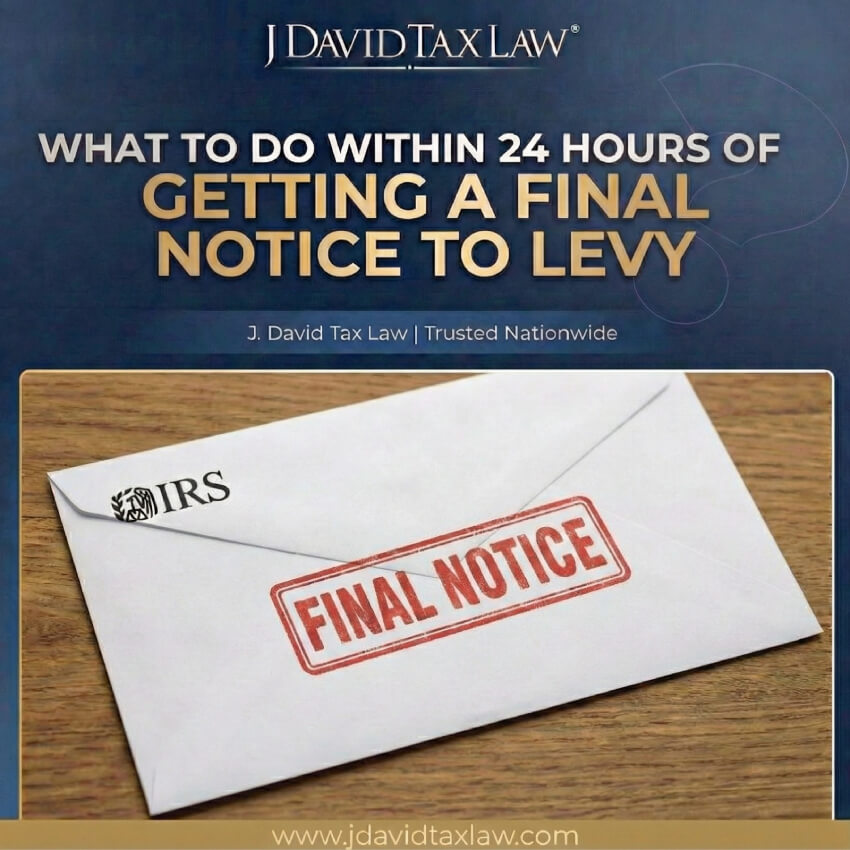
Receiving a Final Notice of Intent to Levy from the IRS is a serious legal warning that means the IRS is about to seize your wages, bank accounts, property, or other assets to collect unpaid taxes. This notice, typically Letter 1058, LT11, or Letter 3172, gives you exactly 30 days to respond before the IRS can legally begin taking your income and property.
The first 24 hours after receiving this notice are critical. While you have 30 days total, the actions you take immediately can determine whether you successfully stop the levy or lose control of your finances. Many taxpayers make the mistake of setting the notice aside, believing they have plenty of time to respond. By the time they act, they have missed important deadlines or made errors that weaken their position.
This guide walks you through the exact steps you must take within the first 24 hours of receiving a Final Notice of Intent to Levy. These steps are designed to protect your rights, preserve your financial options, and give you the strongest possible chance of stopping the IRS before enforcement begins.
Key Takeaways:
- A Final Notice of Intent to Levy gives you 30 days to respond before the IRS can seize wages, bank accounts, or property.
- The first 24 hours are critical for gathering information, understanding your rights, and beginning the response process.
- Filing IRS Form 12153 within 30 days stops most IRS collection actions, including levies and garnishments.
- Ignoring the notice or waiting too long eliminates your strongest legal protections and allows the IRS to move forward with enforcement.
- You do not need to pay the full balance immediately, payment plans, settlements, and hardship status are all available if you act quickly.
- A tax attorney can stop levies in as little as 48 hours and negotiate a resolution that protects your income and assets.
What Is a Final Notice of Intent to Levy?
A Final Notice of Intent to Levy is the IRS’s last warning before it begins seizing your property, income, or assets to collect unpaid taxes. This notice is not a suggestion or a reminder, it is a legal notification that the IRS has completed its internal review and is now authorized to take enforced collection action.
The most common forms of this notice are:
- Letter 1058 (Final Notice of Intent to Levy and Notice of Your Right to a Hearing)
- LT11 (Final Notice – Notice of Intent to Levy and Your Right to a Hearing)
- Letter 3172 (Notice of Federal Tax Lien Filing and Your Right to a Hearing for Certain Unpaid Taxes)
What the Notice Means
- The IRS has assessed a tax liability against you and issued multiple prior notices demanding payment.
- You did not pay the balance or set up a resolution.
- The IRS has now sent the final notice required by law before it can levy your property.
- You have 30 days from the date on the notice to respond or appeal.
- After 30 days, the IRS can seize wages, bank accounts, Social Security benefits, retirement distributions, business income, and physical property.
Why This Notice Is Different From Earlier IRS Letters
Earlier IRS notices, such as CP14, CP501, CP503, and CP504, are billing notices and warnings. They do not give the IRS the legal authority to levy your assets. The Final Notice of Intent to Levy is the only notice that triggers your Collection Due Process (CDP) appeal rights and authorizes the IRS to begin enforced collection.
Once you receive this notice, the situation has moved from “billing” to “enforcement.” Your response time is limited, and your legal protections depend on acting within the 30-day window.
Step 1: Verify the Notice Is Legitimate
The first thing you must do within 24 hours is confirm that the notice you received is a genuine IRS document. The IRS does not initiate contact by email, text message, or phone call demanding immediate payment. Scammers frequently impersonate the IRS, especially when using fear and urgency to pressure victims into sending money.
How to Verify the Notice Is Real
- Check the IRS logo, letterhead, and formatting, legitimate IRS notices use official branding and are printed on government letterhead.
- The notice should arrive by U.S. Postal Service certified mail with a return receipt.
- The notice will include your Social Security Number or Employer Identification Number, the tax years in question, and the amount owed.
- The notice will reference your right to appeal and provide instructions for filing Form 12153.
- The notice will list a specific IRS office address where you can send your response.
If you are unsure whether the notice is real, contact the IRS directly using the phone number listed on IRS.gov, not the number printed on the notice. You can also call J. David Tax Law at (888) 342-9436 to have a tax attorney verify the notice for you.
Step 2: Read the Entire Notice Carefully
Many taxpayers skim the notice or focus only on the balance due. This is a mistake. The Final Notice of Intent to Levy contains critical information that determines your next steps and your legal rights.
What to Look For in the Notice
- Tax years and periods covered: Identify which years the IRS is collecting on.
- Total amount due: This includes the original tax, penalties, and interest.
- Notice date: The 30-day appeal period begins on the date printed on the notice, not the date you received it.
- Appeal instructions: The notice will explain how to request a Collection Due Process Hearing by filing Form 12153.
- IRS contact information: The notice will list the IRS office handling your case and provide an address for correspondence.
- Your rights: The notice will outline your right to appeal, your right to representation, and your right to propose alternative resolutions.
Understanding these details allows you to respond accurately and protects you from missing important deadlines.
Step 3: Calculate Your Deadline
The IRS gives you 30 days from the date on the notice to file Form 12153 and request a Collection Due Process Hearing. This is not 30 days from when you receive the notice, it is 30 days from the date printed on the letter.
How to Calculate Your Deadline
- Look at the date at the top of the notice.
- Count forward 30 calendar days.
- If the 30th day falls on a weekend or federal holiday, your deadline extends to the next business day.
Example:
- Notice date: January 5, 2025
- 30-day deadline: February 4, 2025
If you mail Form 12153, the IRS uses the postmark date to determine if it was filed on time. Always send the form by certified mail with tracking so you have proof of the mailing date.
Mark this deadline on your calendar and set reminders. Missing the 30-day window eliminates your strongest legal protections.
Step 4: Do Not Ignore the Notice or Wait
One of the most damaging mistakes taxpayers make is setting the notice aside and assuming they will deal with it later. The 30-day deadline is firm, and the IRS will not grant extensions simply because you were busy or did not understand the notice.
What Happens If You Ignore the Notice
- The IRS can begin levying your wages, bank accounts, Social Security benefits, and other income after the 30-day period expires.
- You lose the right to a Collection Due Process Hearing, which is your strongest legal protection against enforced collection.
- You lose the automatic stay on collection that filing Form 12153 provides.
- You lose the right to appeal the levy decision to the U.S. Tax Court.
- Your only remaining option is an Equivalent Hearing, which does not stop collection and provides weaker protections.
Even if you cannot pay the full balance, you must still respond to the notice. Payment plans, settlements, and hardship options are available, but only if you act within the 30-day window.
Step 5: Gather Your Financial Information
If you plan to request a payment plan, Offer in Compromise, or Currently Not Collectible status, you will need to provide the IRS with detailed financial information. Start gathering these documents within the first 24 hours so you are prepared to submit them quickly.
Financial Documents You May Need
- Recent pay stubs or proof of income
- Bank statements for the past three months
- Monthly living expenses (rent, mortgage, utilities, groceries, transportation)
- Information on any debts or liabilities
- List of assets (vehicles, property, investments, retirement accounts)
- Profit and loss statements if you are self-employed
Having this information ready allows you to move quickly once you decide on your resolution strategy.
Step 6: Understand Your Options to Stop the Levy
You have several options for stopping an IRS levy, and the best choice depends on your financial situation and the amount you owe. Within the first 24 hours, you should begin evaluating which option makes the most sense for your circumstances.
Option 1: File Form 12153 to Request a Collection Due Process Hearing
Filing Form 12153 is the most powerful tool available to stop an IRS levy. Once you file this form within 30 days, the IRS must pause most collection actions, including wage garnishments and bank levies, while your case is reviewed by the Independent Office of Appeals.
During the CDP hearing, you can:
- Challenge the underlying tax liability if you did not previously have an opportunity to dispute it
- Propose an installment agreement
- Request an Offer in Compromise
- Apply for Currently Not Collectible status
- Request penalty abatement
- Raise defenses such as innocent spouse relief
A CDP hearing gives you the right to appeal to the U.S. Tax Court if you disagree with the Appeals Officer’s decision.
Option 2: Set Up an Installment Agreement
An installment agreement allows you to pay your tax debt in monthly payments over time. Once the agreement is approved, the IRS will not levy your wages or bank accounts as long as you remain in compliance with the payment terms.
Option 3: Request Currently Not Collectible Status (CNC)
If you cannot afford to pay anything toward your tax debt without causing financial hardship, you may qualify for CNC status. This temporarily pauses IRS collection while you work to stabilize your finances.
Option 4: Apply for an Offer in Compromise (OIC)
An OIC allows you to settle your tax debt for less than the full amount owed if you can demonstrate that paying the full balance would cause financial hardship. While your application is being reviewed, the IRS generally will not pursue enforced collection.
Option 5: Pay the Tax Debt in Full
If you have the financial ability to pay the full balance, doing so immediately stops the levy process and resolves the issue entirely. This is often the fastest and most certain way to protect your income and assets.
Step 7: Contact a Tax Attorney Immediately
The first 24 hours are the best time to consult with a tax attorney. An attorney can review your notice, explain your options, and begin taking action to protect your rights before the IRS moves forward with enforcement.
Why You Should Not Handle This Alone
- The IRS has the full weight of federal law behind it and years of experience collecting taxes.
- One mistake in your response can cost you your legal protections.
- The IRS is not required to tell you about every option or relief program you may qualify for.
- An attorney can communicate directly with the IRS on your behalf, preventing you from saying something that weakens your case.
- An attorney can often stop wage garnishments and bank levies in as little as 48 hours.
What a Tax Attorney Can Do for You
- Review your Final Notice of Intent to Levy and confirm your deadline
- File Form 12153 to request a CDP Hearing and stop the levy
- Negotiate directly with the IRS to set up a payment plan or settlement
- Represent you during the Collection Due Process Hearing
- Present financial documentation and legal arguments that support your case
- Protect your income, bank accounts, and assets while a resolution is prepared
If you received a Final Notice of Intent to Levy, call J. David Tax Law immediately at (888) 342-9436. Our tax attorneys can stop IRS levies and protect your financial stability.
Step 8: Prepare to File Form 12153
Form 12153 is the official IRS form you must submit to request a Collection Due Process Hearing. You should begin preparing this form within the first 24 hours, even if you plan to hire an attorney to complete it for you.
What Form 12153 Requires
- Your personal information (name, address, Social Security Number or EIN)
- The tax years and periods you are appealing
- A description of the IRS action you are challenging (levy, lien, etc.)
- The reason for your appeal (e.g., financial hardship, dispute of tax amount, request for payment plan)
- Any supporting documents, such as financial statements or prior IRS correspondence
How to Submit Form 12153
- Mail the form to the address listed on your Final Notice of Intent to Levy.
- Send it by certified mail with return receipt so you have proof of mailing.
- Keep a copy of the form and all supporting documents for your records.
The IRS uses the postmark date to determine if the form was filed on time, so mailing it before the 30-day deadline protects your appeal rights even if the IRS receives it later.
Step 9: Protect Your Bank Accounts and Income Immediately
If you have not yet filed Form 12153 or set up a payment plan, the IRS can levy your bank account or wages at any time after the 30-day period expires. Taking protective steps now can reduce the financial damage if the IRS acts quickly.
Steps to Protect Your Finances
- Move funds to cover essential living expenses before the IRS levies your account.
- Inform your employer that you are working to resolve the tax debt and may need payroll adjustments if a garnishment is issued.
- Set up automatic payments for critical bills so you do not miss payments if your account is frozen.
- Open a separate account for essential expenses only, though be aware the IRS can levy any account in your name.
These steps do not stop the levy, but they can give you temporary breathing room while you work on a formal resolution.
Step 10: Take Action Before the 30-Day Deadline Expires
The most important thing you can do within the first 24 hours is commit to taking action. The 30-day deadline will arrive faster than you expect, and waiting until the last minute increases the risk of errors, missed deadlines, and lost protections.
Your 30-Day Action Plan
- Days 1-2: Verify the notice, calculate your deadline, and contact a tax attorney.
- Days 3-7: Gather financial documents and evaluate your resolution options.
- Days 8-20: File Form 12153, set up a payment plan, or begin negotiating with the IRS.
- Days 21-30: Confirm your response was received and follow up if necessary.
Real Case Example: Levy Stopped in 48 Hours
Detail | Information |
Client | Self-Employed Consultant – Florida |
Tax Debt | $42,000 in unpaid income taxes |
IRS Action | Final Notice of Intent to Levy received; wage garnishment scheduled to begin in 10 days |
Attorney Intervention | Immediate filing of Form 12153 to legally pause the levy; submission of financial hardship package and proposal of an installment agreement. |
Outcome | The IRS approved the payment plan, and the levy was permanently stopped. |
Time to Resolution | 48 hours from initial contact. |
Conclusion
Receiving a Final Notice of Intent to Levy is a serious legal warning, but it is not the end of your options. The first 24 hours after receiving this notice are your most important opportunity to protect your income, bank accounts, and assets from IRS seizure.
By verifying the notice, calculating your deadline, gathering financial information, understanding your options, and contacting a tax attorney immediately, you give yourself the strongest possible chance of stopping the levy and negotiating a resolution that works for your financial situation.
Do not wait. The IRS will not give you extra time simply because you were unprepared or did not understand the notice. Act within the first 24 hours, and protect your financial future.
If you received a Final Notice of Intent to Levy, call J. David Tax Law now at (888) 342-9436.
Frequently Asked Questions
A Final Notice of Intent to Levy is the IRS’s last warning before it seizes your wages, bank accounts, or property to collect unpaid taxes. This notice gives you 30 days to respond or appeal before the IRS can begin enforced collection.
You have 30 days from the date on the notice to file Form 12153 and request a Collection Due Process Hearing. Missing this deadline eliminates your strongest legal protections and allows the IRS to move forward with levies and garnishments.
Yes. Filing Form 12153 within 30 days stops most IRS collection actions, including levies and wage garnishments, while your case is reviewed. You can also stop a levy by setting up a payment plan, paying the debt in full, or requesting hardship status.
If you ignore the notice, the IRS can seize your wages, bank accounts, Social Security benefits, retirement distributions, and property after the 30-day period expires. You also lose the right to a Collection Due Process Hearing and the right to appeal to Tax Court.
While you can respond on your own, a tax attorney significantly increases your chances of stopping the levy and negotiating a favorable resolution. An attorney can file Form 12153, represent you during the CDP hearing, and protect your income and assets while the case is resolved.