





Last updated on January 9th, 2026 at 05:47 am
If you are audited and the IRS determines you underreported income, claimed improper deductions, or failed to substantiate your return, you may be found guilty of tax violations. When that happens, the IRS can impose substantial penalties, add years of interest, assess back taxes, and in severe cases pursue civil fraud penalties or even criminal tax charges.
IRS audits are more common than most people think. In fiscal year 2023, the IRS audited 582,944 tax returns and assessed nearly $31.9 billion in additional taxes. These audits did not target only high-income households. In fact, the IRS frequently audits lower-income taxpayers who claim the Earned Income Tax Credit (EITC), making both individuals and business owners vulnerable to review.
Key Takeaways:
What Happens If You Are Audited and Found Guilty?
- If you knowingly fail to file required tax returns, refuse to pay taxes, or do not maintain proper financial records, you can face up to one year in federal jail for each year you didn’t file, along with fines of up to $25,000 per year.
- If the IRS concludes that a return you submitted was intentionally false, you may be subject to as much as three years in prison and fines reaching $100,000 for filing a fraudulent return.
If you engage in tax evasion—such as hiding income, moving assets, or misrepresenting your finances to avoid paying tax—you could face up to five years of imprisonment and fines as high as $250,000, in addition to repayment of the tax, penalties, and interest.
Your Audit Has a Defense — Here’s Proof
What We’ve Saved Clients in IRS and State Audits
J. David Tax Law handles audits every day, challenging examiners, correcting errors, providing substantiation, and pursuing relief when records are missing or destroyed. Our attorneys have resolved complex, high-dollar audits for clients across the country. Here are a few examples:
IRS Audit — $182,000 Assessment Eliminated
Our client was told they owed more than $182,000 in tax, penalties, and interest. We challenged the audit line by line, rebuilt the defense, and forced the IRS to reverse the entire assessment. The case was closed with zero balance owed.
California Sales Tax Audit — Reduced From $106,520 to $17,927
The California Department of Tax and Fee Administration assessed over $100,000 because the taxpayer lacked documentation. We built an Offer in Compromise that addressed the auditor’s findings and secured acceptance for just $17,927, preventing garnishment of out-of-state income.
Texas Comptroller Audit — $126,000 Abated and Tax Lien Withdrawn
Texas wrongly assessed a business $126,000 in sales and withholding tax and filed a lien. We proved the client had no taxable nexus in Texas. The auditor removed the full assessment and withdrew the lien entirely.
South Carolina Audit — $68,408 Reduced to $5,538
After a three-year examination, the IRS proposed nearly $70,000 in tax. We worked the case directly with the state and IRS, correcting the underlying issues and reducing the balance to $5,538, saving the client over $62,000.
New York Audit — $917,667 Fully Abated for Overseas Client
New York claimed our client — who had not lived in the United States for 10+ years — owed nearly $1 million. After proving foreign residency, correcting W-2 sourcing errors, and filing accurate non-resident returns, the state abated 100% of the assessment.
Schedule C Audit — Nearly $600,000 Saved After Records Destroyed
A flood destroyed our client’s substantiation, and the IRS disallowed large Schedule C expenses across two years. After taking the case to Appeals and using market-based expense analysis, the IRS allowed nearly all business expenses and waived accuracy-related penalties. The client avoided almost $600,000 in tax and penalties.
Common Reasons for IRS Audit Penalties and Fees
IRS audit penalties often stem from specific issues the IRS identifies in a return or during the examination process. Knowing these triggers helps taxpayers understand why penalties occur and how quickly an audit can escalate if not handled properly.
Not Responding To an Audit Notice
Failing to respond is one of the most damaging mistakes a taxpayer can make. When you do not reply, the IRS simply finalizes its proposed adjustments and assesses the full amount of tax, penalties, and interest. Many people feel overwhelmed or unsure what to do, but delaying communication only strengthens the IRS’s position and limits your options.
Got an IRS audit? Read our expert guide.
Underestimating The Amount of Tax Due
Even honest mistakes can lead to significant penalties. Income from contract work, digital payments, investments, or part-time earnings is often overlooked. The IRS matches your return to third-party reports, and when the numbers don’t align, it assumes underreporting and may apply accuracy-related penalties.
Deductions You Cannot substantiate
Every deduction requires documentation. If the IRS requests proof and you cannot provide receipts, logs, mileage records, or bank statements, those deductions are removed. This happens frequently when records are lost due to moves, natural disasters, personal hardship, or years of disorganized bookkeeping. Lack of documentation doesn’t imply fraud, but it does lead to added tax and penalties.
Types of IRS Audit Penalties
When the IRS finishes an audit and finds errors, it issues penalties based on the type of mistake and how serious the IRS believes the conduct was. These penalties can add substantial cost to an already stressful situation, especially when interest accumulates on top of the tax owed.
Accuracy-Related Penalties
These penalties apply when the IRS believes the return contains careless mistakes, substantial understatements of income, or unsupported deductions. They are typically 20% of the additional tax the IRS says you owe. Even if the mistake wasn’t intentional, the IRS may still apply this penalty unless you can show you acted reasonably.
Tax Fraud Penalties
A civil fraud penalty is one of the most severe outcomes of an audit. If the IRS determines that a taxpayer intentionally attempted to avoid paying tax, the penalty can be as high as 75% of the underpayment. While true fraud cases are less common, the IRS will pursue this penalty when it believes the evidence shows deliberate wrongdoing.
Failure-to-File Penalties
If you did not file a required return for the year under audit, the IRS may assess a penalty of up to 25% of the unpaid tax. This often occurs when a taxpayer falls behind during a difficult period and later becomes the subject of an audit. Even when circumstances were beyond your control, the IRS treats unfiled returns as a serious compliance issue.
Make Your Complaint Count: J. David Tax Law’s Strategy Against IRS Penalties
Potential Consequences of Failing an IRS Audit
Failing an IRS audit can trigger a series of financial and legal consequences that extend far beyond the year under review. While most cases remain civil, the IRS takes audit findings seriously, and the fallout can quickly become overwhelming without experienced representation.
Additional Scrutiny on Past Returns
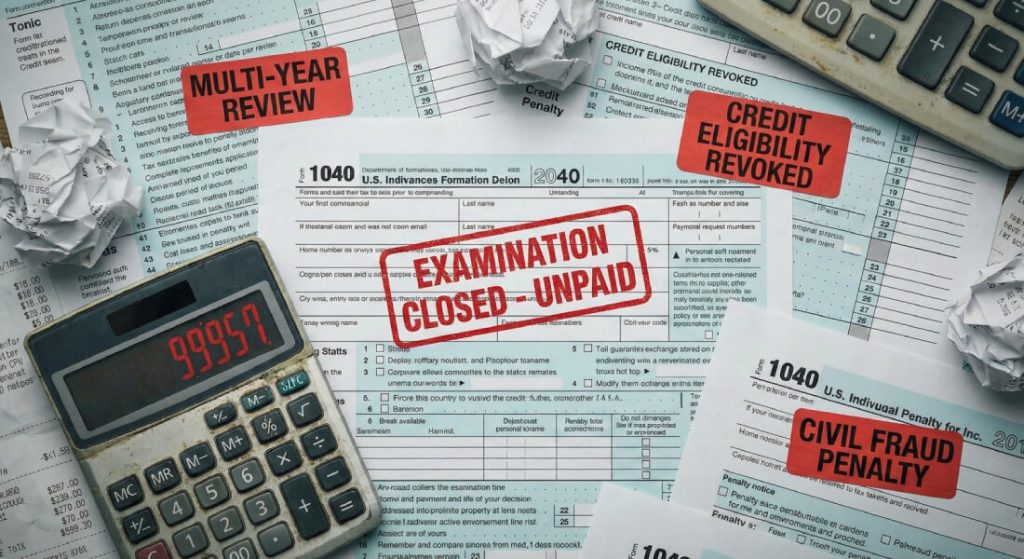
When the IRS identifies errors in one tax year, it often expands its review to earlier returns. This can lead to multiple years of adjustments, additional penalties, and a significantly higher balance. Many taxpayers first learn that one audit has become three only after the IRS begins issuing new notices.
Future Loss of Credits
Certain credits—especially refundable ones like the Earned Income Tax Credit—carry strict qualification rules. If the IRS believes a credit was claimed improperly, you can lose eligibility for two to ten years and may be required to complete a formal recertification process before claiming it again.
Late Payment or Late Filing Penalties
Any tax uncovered during an audit is treated as though it was unpaid from the original due date of the return. This means the IRS can apply both late filing and late payment penalties, stacking them on top of the audit assessment and increasing your overall liability.
Interest
Interest begins accruing from the day the return was originally due and continues daily until the balance is paid. For many taxpayers, interest becomes the fastest-growing part of an audit bill and can make even a modest adjustment feel unmanageable.
Fraud Penalties
If the IRS believes the issue goes beyond an honest mistake, it may assert a civil fraud penalty of up to 75% of the underpayment. While most audits do not rise to this level, the IRS does look for signs of intentional behavior—such as omitted income, altered records, or inconsistent statements.
How IRS Audit Penalties Are Calculated
Penalty Type | How It’s Calculated | What Triggers It |
Accuracy-Related Penalty | 20% of the additional tax the IRS says you owe | Negligence, substantial understatement of income, unsupported deductions, bookkeeping errors |
Civil Fraud Penalty | 75% of the unpaid tax tied to fraudulent behavior | Intentional underreporting, hiding income, falsifying records |
Failure-to-File Penalty | 5% of the unpaid tax per month, up to 25% total | Not filing a required tax return by the deadline |
Failure-to-Pay Penalty | 0.5% of the unpaid tax per month, up to 25% total | Not paying the tax due by the original deadline |
Interest | Accrues daily on tax + penalties from the original due date | Applies to all unpaid taxes and penalties until fully paid |
Note: Certain complex valuation cases—such as property or pension valuation disputes—can lead to separate 20%–40% penalties. These usually apply to specialized business or estate-related matters, not standard individual audits.
The IRS is Forgiving Millions Each Day. You Could Be Next.
How Do You Mitigate IRS Audit Penalties?
The IRS offers several avenues for reducing or removing penalties when you can show good-faith effort, reasonable cause, or circumstances beyond your control. These relief options can significantly lower your balance if applied correctly and supported with proper documentation.
Failure-to-File Penalty Relief
You may qualify for relief if you can show that illness, natural disaster, a family crisis, or another unavoidable circumstance prevented you from filing on time. A clear explanation and supporting records strengthen your case.
Information Return Penalty Relief
Late or corrected forms—such as 1099s or W-2s—may qualify for relief when you can demonstrate that you acted promptly to fix the issue once you became aware of it.
Reasonable Cause Relief
If you exercised ordinary care but still made an error, the IRS may remove or reduce the penalty. Common examples include reliance on incorrect professional advice, lost records due to events outside your control, or significant personal hardship during the filing year.
Accuracy-Related Penalty Relief
The IRS may reduce the 20% accuracy penalty if you can show that the mistake was unintentional and that you acted in good faith. Providing additional documentation during the audit often helps support this claim.
Payment Plan Options
If the balance is too large to pay at once, an IRS installment agreement can prevent enforced collection actions like levies or garnishments. While it doesn’t remove penalties, it protects you while you resolve the debt.
Interest Abatement
Interest is rarely removed, but in situations where the IRS caused delays or made procedural errors, you may qualify for partial relief. An IRS audit attorney can determine whether your case meets the IRS’s strict requirements.
What Happens If You Are Audited and Found Guilty of Tax Evasion?
Tax evasion is one of the most serious allegations the IRS can make. While most audits result in civil penalties, cases involving intentional concealment of income or assets can escalate into criminal investigations. When the IRS believes a taxpayer acted deliberately, the consequences become far more severe.
Can the IRS Arrest You?
Yes, but only in cases where the IRS can prove willful misconduct. The IRS does not arrest people for simple mistakes, missing receipts, or bookkeeping errors. Arrests occur when agents believe income was intentionally hidden, records were falsified, or the taxpayer took active steps to avoid paying tax.
Can the IRS Send You to Jail?
Jail time is possible, but it is reserved for the most serious violations. Examples include intentionally falsifying a tax return, destroying or altering financial records, or hiding assets in an attempt to mislead auditors. These cases are investigated by IRS Criminal Investigation and prosecuted by the U.S. Department of Justice, not by regular auditors.
When to Get a Tax Attorney Involved?
- Right when the audit notice arrives
The earlier an attorney steps in, the more control you have over the direction of the audit. - When you’re unsure what the IRS is asking for
Attorneys help interpret requests, organize records, and prevent avoidable mistakes. - If you lack documentation or disagree with the IRS’s findings
Missing receipts or unclear explanations can be used against you. A tax attorney manages how information is presented. - When the audit starts expanding into other years
Professional representation helps contain the scope and challenge assumptions before they become formal assessments. - Before speaking directly with an auditor
Anything said during an audit interview can be misinterpreted. Attorneys speak on your behalf and protect your rights. - If penalties or fraud concerns appear
Once the IRS raises accuracy penalties or suggests potential misconduct, every response becomes critical.
Need Help Dealing With an IRS Audit Penalty?
If you’re dealing with an IRS audit or penalties, experienced legal guidance can make a meaningful difference. J David Tax Law has helped clients reduce millions in IRS and state audit assessments. Call us at (888) 342-9436 & speak with an audit attorney about your situation today.
Conclusion
If you are audited and the IRS finds intentional errors, missing records, or underreported income, the consequences can include added tax, penalties, interest, and—in rare cases involving willful misconduct—criminal charges. Most audit outcomes remain civil, but the financial impact can be significant without a clear response strategy.
Having the right legal guidance helps you correct issues, and prevent an audit from expanding into additional years or penalties. J. David Tax Law has helped clients reduce millions in proposed IRS and state audit assessments.If you’ve received an audit notice or disagree with an IRS finding, our attorney can help you understand your options and protect your financial standing moving forward.
Related Topics:
IRS Audits: Why Hiring a Tax Attorney Makes All the Difference
What Is IRS Audit Representation? Tax Audit Mistakes, Red Flags, and Benefits of Defense
The Truth Behind IRS Penalties: Are You Being Unfairly Targeted?
IRS Penalty Abatement: Ways to Reduce or Eliminate Your Tax Penalties
How Far Back Can the IRS Go? Understanding Audit Timelines and Lookback Periods
Frequently Asked Questions
You can only go to jail if the IRS proves intentional tax fraud or evasion. Regular audit errors, missing receipts, or honest mistakes do not lead to jail time.
The IRS reviews your income, deductions, and records to confirm accuracy. If they find discrepancies, you may owe additional tax, penalties, and interest.
The IRS will complete the audit without your input and assess the full tax, penalties, and interest. You lose the chance to dispute errors or submit documents.
If the IRS proves willful misconduct, you may face criminal charges, fines, and— in severe cases—prison. Most taxpayers, however, receive civil penalties only.
Refunds are paused until the audit finishes. If everything checks out, the IRS releases the refund. If changes are made, the refund may be reduced.
Simple correspondence audits take a few weeks to a few months. More complex office or field audits can last six months to a year or longer.