





Last updated on November 25th, 2025 at 02:36 am
When a joint tax return includes unreported income or incorrect deductions, the IRS can hold both spouses responsible under joint and several liability. This applies even if only one spouse caused the issue.
IRS Form 8857 (Request for Innocent Spouse Relief) allows a spouse to ask the IRS to remove their responsibility for taxes, penalties, and interest resulting from the other spouse’s actions.
This blog outlines what Form 8857 is, when it should be filed, the types of relief available, eligibility requirements, and the steps involved in the process. Form 8857 may provide protection if it would be unfair to hold you liable for a tax debt created by your spouse or former spouse.
Key Takeaways
- Form 8857 allows you to request removal of tax liability caused by a spouse or former spouse.
- Innocent Spouse Relief only applies to joint returns and requires you had no knowledge of the error.
- Multiple types of relief exist, and choosing the correct one is critical.
- Filing deadlines matter—most cases must be filed within two years of IRS collection action.
Professional guidance increases approval rates and helps avoid common mistakes.
What Is Innocent Spouse Relief?
Innocent Spouse Relief is an IRS provision that allows a taxpayer to be released from responsibility for additional tax, penalties, and interest that result from a spouse’s or former spouse’s errors on a joint tax return. This relief is available when one spouse was unaware of the inaccurate information and it would be unfair to hold them liable.
When Innocent Spouse Relief is granted, the IRS removes the portion of the tax liability that is attributable to the other spouse’s erroneous items, such as:
- Unreported income
- False or inflated deductions
- Incorrect credits or expenses
The key requirement is that the requesting spouse did not know and had no reason to know about the error at the time the return was signed.
What Is IRS Form 8857?
IRS Form 8857 (Request for Innocent Spouse Relief) is the official form used to ask the IRS to remove your liability for a tax debt caused by your spouse or former spouse on a joint tax return. It is not filed with a tax return. Instead, it is submitted separately by mail or fax directly to the IRS for review.
Form 8857 allows you to explain:
- Why you should not be held responsible for the tax debt
- What errors were made on the joint return
- Whether you knew or had reason to know about the issue
- Your marital status and involvement in the return
What Form 8857 Is Not
To avoid confusion:
- It is not used to split a refund taken for a spouse’s debts (that is Form 8379 – Injured Spouse Allocation).
- It is not filed with a tax return.
- It is not a payment plan or settlement.
Form 8857 is specifically for requesting relief from joint tax liability due to a spouse’s erroneous items.
👉 Innocent Spouse tax form offers a way to seek relief, but navigating the details isn’t always easy. We’re here to help you through every step—start your free consultation today and protect yourself from unfair tax burdens.
The IRS is Forgiving Millions Each Day. You Could Be Next.
Understanding Joint and Several Liability
When spouses file a joint tax return, the IRS treats both individuals as jointly and severally liable for the entire tax balance. This means:
- Each spouse is legally responsible for 100% of the tax owed.
- The IRS can collect the full amount from either spouse.
- Liability applies even if only one spouse earned the income or made the mistake.
- Divorce or separation does not eliminate responsibility.
For example, if one spouse failed to report income or claimed incorrect deductions, the IRS can still pursue the other spouse for the resulting tax, penalties, and interest.
This rule is the reason Innocent Spouse Relief and tax Form 8857 exist. If it is unfair to hold you liable for the mistakes of your spouse or former spouse, the IRS allows you to request relief from this joint liability.
Innocent Spouse Relief vs Injured Spouse Relief
Although they sound similar, Innocent Spouse Relief and Injured Spouse Relief serve two completely different purposes and use different IRS forms.
Feature | Innocent Spouse Relief | Injured Spouse Relief |
Purpose | Remove liability for spouse’s tax errors | Recover your share of a refund taken for spouse’s debts |
IRS Form | Form 8857 | Form 8379 |
When used | Spouse understated tax or made mistakes on joint return | IRS used joint refund to pay spouse’s debt (e.g., child support, student loans, taxes) |
Knowledge of error required | Must prove you didn’t know | Not based on knowledge |
Outcome | You may be removed from tax liability | You may get part of your refund back |
Which One Should You Use?
- Use Form 8857 if you are trying to avoid liability for a spouse’s tax debt.
- Use Form 8379 if your portion of a joint refund was taken to pay your spouse’s debts.
- In some cases, a taxpayer may qualify for both, but they are separate requests.
When Should You File Innocent Spouse Form 8857?
Form 8857 should be filed when you become aware of a tax liability on a joint return that you believe should be the sole responsibility of your spouse or former spouse. This typically occurs when the IRS identifies an issue on the return and attempts to collect additional tax.
Common situations include:
- Receiving an IRS notice about additional tax, penalties, or interest
- The IRS audits a prior joint return and finds unreported income
- The IRS adjusts deductions or credits claimed by your spouse
- Your tax refund is intercepted to pay your spouse’s tax debt
- You discover financial misconduct after divorce or separation
In these instances, IRS form 8857 allows you to request relief from liability for the portion of the tax debt caused by your spouse’s erroneous items.
The 2-Year Rule
In most cases, Form 8857 must be filed within two years of the IRS’s first collection action, such as:
- A notice of intent to levy
- A wage garnishment
- An offset of your tax refund
A final notice of balance due
👉 Curious how our tax attorneys simplify the process of filing IRS Form 8857? See our process
Situations Where You Should Not File Form 8857
Not every situation qualifies for Innocent Spouse Relief. There are specific circumstances where the IRS will deny Form 8857 or where another form of relief may be more appropriate.
If a court has already issued a final decision on whether you are liable for the tax, and relief was denied, you cannot file Form 8857 again for the same tax year. This applies even if you participated in the case but did not request relief at the time.
If you previously signed an installment agreement, offer in compromise, or closing agreement that resolved the same tax liability, you may be ineligible to file Form 8857. Limited exceptions apply in certain cases, such as TEFRA partnership proceedings.
If you are still married and living with your spouse, or you have not lived apart for at least 12 months, you generally will not qualify for Separation of Liability Relief. However, Innocent Spouse Relief or Equitable Relief may still be available.
Not sure which relief applies? See the four types of innocent spouse relief.
If the IRS has not issued a notice of additional tax or begun collection actions, an innocent spouse tax form may not be necessary. Relief is only available for tax years involving your spouse’s or former spouse’s erroneous items.
IRS innocent spouse relief form only applies to joint tax returns. If you filed separately, Innocent Spouse Relief does not apply.
If you knew or had reason to know about the unreported income or incorrect deductions at the time you signed the return, the IRS may deny relief.
Knowing when not to file Form 8857 can help you avoid delays and pursue the most effective tax resolution strategy. In situations where Innocent Spouse Relief does not apply, our tax attorneys can help you explore alternatives such as Equitable Relief, audit reconsideration, or other IRS programs. Call us at (888) 342-9436 for immediate relief.
Types of Relief Available with Form 8857
When you file Form 8857, the IRS provides several types of relief to help you manage unexpected tax liabilities stemming from your spouse’s or former spouse’s actions. Here’s a detailed look at each type of relief from liability for tax that you may be eligible for:
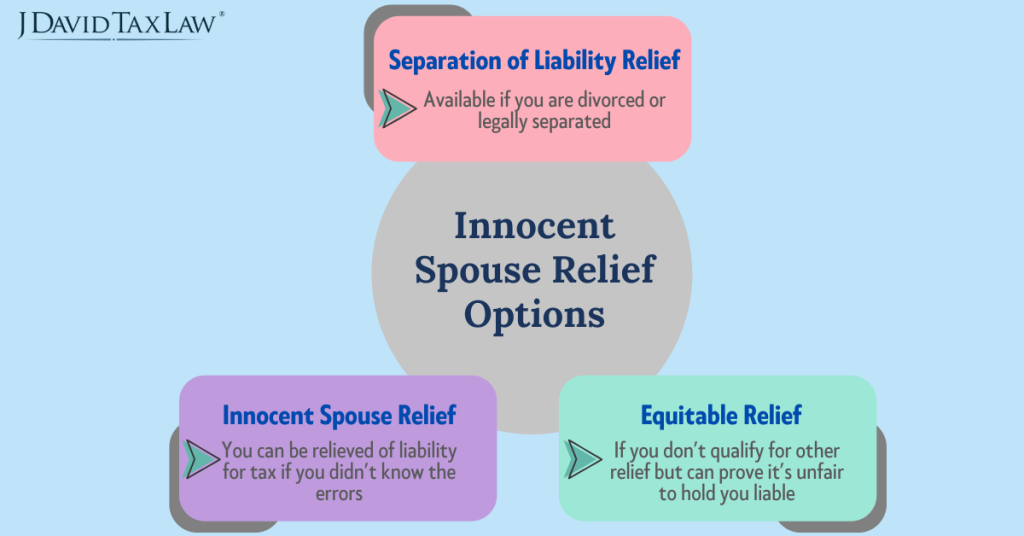
Innocent Spouse Relief
Innocent Spouse Relief is the most commonly used form of relief. It’s designed to protect you if your spouse or former spouse is responsible for erroneous items that caused an additional tax liability on your joint income tax return. To qualify, you must show that when you signed the return, you didn’t know, and had no reason to know, that the tax was understated due to your spouse’s actions. This type of relief is especially useful when there are unreported income or incorrect deductions made by your spouse that you were unaware of at the time.
- You can request innocent spouse relief if it would be unfair to hold you liable for the tax debt based on all facts and circumstances.
- You remain eligible for partial relief if you knew about some, but not all, of the erroneous items.
Separation of Liability Relief
If you are now divorced, legally separated, or have been living apart for a 12-month period, you may qualify for Separation of Liability Relief. This option allows you to separate the tax debt between you and your spouse or former spouse, assigning responsibility for the erroneous items only to the spouse responsible for them.
- To qualify for this relief, you must no longer be married or have been living apart for a full 12-month period.
- This type of relief is ideal for those who want to ensure they’re only responsible for their share of the tax, not for their spouse’s errors.
Equitable Relief
When you don’t qualify for Innocent Spouse Relief or Separation of Liability Relief, you might still be eligible for Equitable Relief. This form of relief is available when the IRS determines that it would be unfair to hold you liable for the tax debt, considering your financial situation and the circumstances surrounding the tax return. This is the only relief option available if the tax was correctly reported on the return but remains unpaid due to an arrangement with your spouse that wasn’t fulfilled.
- Equitable relief is available if holding you responsible would cause economic hardship or if there are other significant factors that make it unfair.
- It’s also useful in cases where your spouse or former spouse left you with unpaid tax debts despite arrangements.
Relief for Community Property States
This type of relief isn’t as common and applies only to those community property states—such as Arizona, California, Texas, or Louisiana—you and your spouse share joint responsibility for community income earned during the marriage. However, under certain circumstances, you may be eligible for relief from liability for tax attributable to an item of community income if your spouse was responsible for the income and you were unaware of it.
- You can request relief if you didn’t include the item in your separate return and can prove you had no knowledge of it.
- Community property laws can complicate tax filings, so relief in these cases may depend on specific facts about your marital status and financial involvement.
IRS Deadlines and Time Limits for Form 8857
When requesting Innocent Spouse Relief, timing is critical. The IRS has strict deadlines for when Form 8857 must be submitted, and missing these time limits can affect the type of relief you qualify for or result in the IRS rejecting your request. Understanding these rules ensures you protect your rights and maintain eligibility.
In most cases, Form 8857 must be filed within two years of the IRS’s first attempt to collect the tax.
The 2-year clock begins when the IRS takes actions such as:
- Notice of Intent to Levy
- Wage or bank garnishment
- IRS refund offset
- Collection demand or payment notice
The deadline may not apply in certain situations, including:
- Requests for Equitable Relief (often no strict 2-year limit)
- The IRS has not started collection activity
- You did not receive proper notice
Circumstances involving domestic abuse or financial control
After Form 8857 is submitted:
- The IRS will notify your spouse or former spouse
- Additional documentation may be requested
A decision typically takes 6 to 12 months, but can take longer
If the IRS denies your relief request, you generally have 30 days to file an appeal with the IRS Office of Appeals or petition the U.S. Tax Court.
How a Tax Attorney Can Help with Form
IRS spousal relief form involves complex IRS rules, documentation requirements, and legal standards. Working with an experienced tax attorney can significantly increase the likelihood of approval. A tax attorney can help by:
- Determining the best type of relief (Innocent Spouse, Separation of Liability, Equitable Relief, or Community Property)
- Preparing a strong explanation that meets IRS standards
- Gathering supporting documents to prove your case
- Communicating with the IRS on your behalf
- Protecting you during spouse notification or disputes
- Filing appeals if the IRS denies your request
.
Need help with Form 8857?
Our attorneys handle innocent spouse cases nationwide and can manage the entire process from start to finish. Book your free consultation now!
Conclusion
IRS Form 8857 offers a path to relief for taxpayers who should not be held responsible for a spouse’s or former spouse’s tax mistakes. However, the IRS applies strict rules, requires detailed documentation, and carefully reviews each request. Knowing when to file, when not to file, which type of relief applies, and how to present your case is essential to improving your chances of approval.
If you believe it is unfair to be held liable for a tax debt you did not create, Innocent Spouse Relief may protect you. The tax attorneys at J. David Tax Law have extensive experience handling innocent spouse cases nationwide and can guide you through every step of the process.
Frequently Asked Questions
Form 8857 is used to request Innocent Spouse Relief from the IRS. It allows a spouse or former spouse to ask the IRS to remove their responsibility for taxes, penalties, and interest that resulted from the other spouse’s errors on a joint tax return, such as unreported income or false deductions.
You may qualify for Innocent Spouse Relief if you filed a joint tax return, the tax liability was caused by your spouse’s erroneous items, you did not know or have reason to know about the error, and it would be unfair for the IRS to hold you responsible. The IRS may also consider factors such as marital status, financial hardship, or abuse when determining eligibility.
Form 8857 protects you from liability; Form 8379 returns your portion of the refund. Form 8857 is used to remove liability for a spouse’s tax debt on a joint return, while Form 8379 is used to recover your share of a refund that was taken to pay your spouse’s past-due debts.
Yes! A tax attorney can help by evaluating your eligibility, preparing the form, collecting supporting documents, and dealing with the IRS on your behalf. They also ensure that your claim is properly presented and submitted in a timely manner. Let the A+ rated tax law firm handle your case today!
Innocent Spouse Relief (you didn’t know about the error), Separation of Liability Relief (you are divorced or living apart), Equitable Relief (it would be unfair to hold you liable), and Community Property Relief (applies in community property states when the income belonged to your spouse).