




Tax debt in America keeps climbing, and many people are searching for a way to start fresh. The IRS received 33,591 Offer in Compromise (OIC) applications in fiscal year 2024 and approved only 7,199, according to the IRS Data Book. That’s an acceptance rate of roughly 21 percent, showing that while the OIC program can be life-changing, approval requires precision and preparation.
An Offer in Compromise allows eligible taxpayers to settle their tax debt for less than they owe. It’s an IRS-approved resolution program that balances fairness with financial reality, but qualifying takes more than filling out a form. The IRS reviews every detail of your financial situation before making a decision.
At J. David Tax Law, we help clients understand what it truly takes to qualify. This guide walks you through every requirement, the documentation you need, and the best practices for submitting a complete and credible Offer in Compromise.
If you’re ready to resolve your tax debt the right way, this is where to begin.
Key Takeaways
- An Offer in Compromise (OIC) lets qualifying taxpayers settle IRS tax debt for less than what they owe. Eligibility depends on your ability to pay, accuracy of documentation, and full tax compliance.
- The IRS approved only 21% of OIC applications in 2024, showing that attention to detail and financial transparency are critical.
- There are three types of eligibility: Doubt as to Collectibility, Doubt as to Liability, and Effective Tax Administration. Each requires specific proof and forms.
- To apply, you’ll need Form 656 and Form 433-A (OIC) or 433-B (OIC), along with detailed financial records and the $205 application fee.
- Avoid common red flags like unfiled returns, inconsistent income, or unrealistic offer amounts.
- A strong OIC submission requires honesty, precision, and full compliance before and after filing.
The IRS is Forgiving Millions Each Day. You Could Be Next.
Do You Qualify for an Offer in Compromise?
Not everyone qualifies for an Offer in Compromise. You can use this IRS qualifier tool to see where you stand. The IRS only accepts offers from taxpayers who can prove they cannot reasonably pay the full amount. Understanding the eligibility types and how the IRS evaluates your finances is the first step toward a legitimate tax settlement.
The Three Types of OIC Eligibility
1. Doubt as to Collectibility
This is the most common reason the IRS accepts an offer. It applies when your income and assets are not enough to cover your total tax debt. If your financial situation makes it unlikely that the IRS could collect the full balance before the statute of limitations expires, you may qualify under this category.
2. Doubt as to Liability
This applies when you have evidence that the IRS incorrectly assessed your tax debt. It could involve an audit error, missing documentation, or a misapplied credit. The IRS requires strong proof before reconsidering what you owe, so supporting documentation is critical.
3. Effective Tax Administration (ETA)
If you can technically afford to pay the full amount but doing so would create an extreme financial hardship, you might qualify under ETA. This category is rare and used only when collecting the full balance would be unfair or inequitable, such as in cases involving serious illness or elderly taxpayers with limited income.
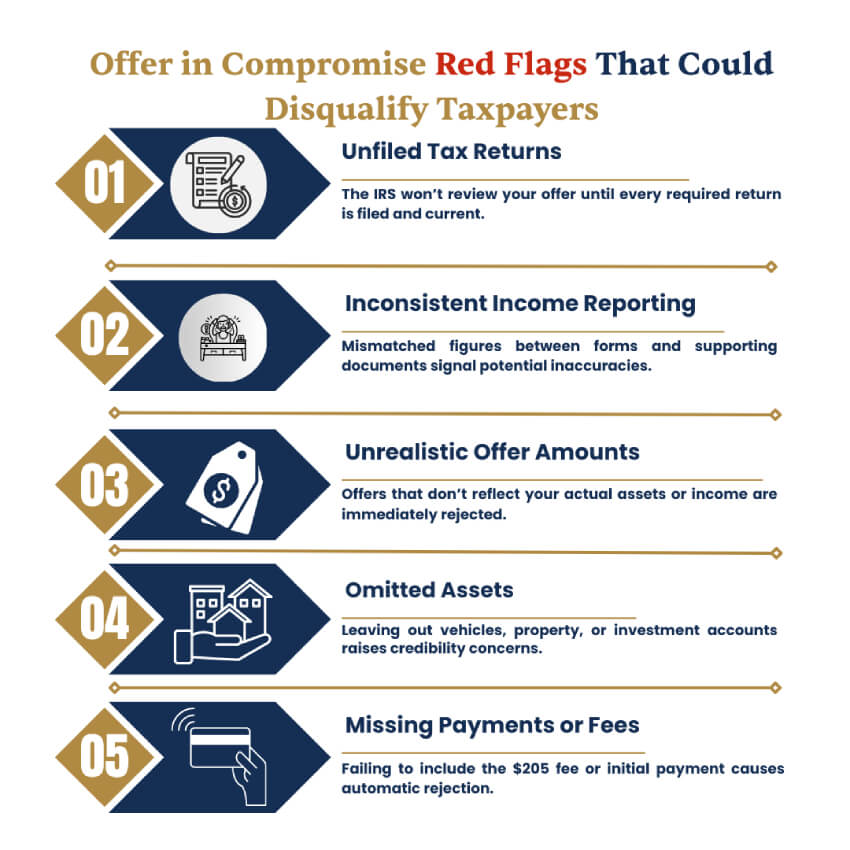
Red Flags That Could Disqualify Taxpayers
The IRS rejects most Offers in Compromise for preventable mistakes. Watch for these five red flags before submitting your application
3 Tips to Prepare a Strong Offer in Compromise Submission
Submitting an Offer in Compromise is more than sending in forms. The IRS expects full compliance, complete documentation, and total transparency. A strong application reflects both accuracy and credibility, which is why most accepted offers come from taxpayers who followed a disciplined process.
Stay Fully Compliant Before You Apply
The IRS will not consider your offer if you have unfiled returns or outstanding estimated tax payments. Every return must be filed, and your estimated taxes or withholdings must be current for the year. This step confirms you are in good standing and shows the IRS that you’re serious about resolving your debt.
If you are self-employed, make sure your current quarter’s estimated taxes are paid. For employees, verify that your withholdings reflect your true income. Any gap in compliance will cause an immediate rejection or delay until you correct the issue.
Maintaining compliance also positions you for faster acceptance once your offer is reviewed. At J. David Tax Law, we often complete this pre-filing phase before the client’s OIC package is ever assembled.
Be Honest, Transparent, and Complete
Every figure you provide is verified against IRS databases, income reports, and third-party records. Attempting to undervalue assets or omit income sources can result in an automatic denial. The IRS uses bank account histories, W-2 and 1099 data, and property records to cross-check your claims.
Transparency also builds credibility. If your financial records show past fluctuations in income, explain them clearly in your Form 433-A (OIC) or 433-B (OIC). A short, factual note about a job loss, medical expense, or market downturn can help the IRS understand why your current ability to pay is limited.
Professional presentation matters. The IRS is more likely to trust an offer that’s consistent, clearly organized, and properly supported with evidence.
Get Professional Help When It Matters Most
IRS acceptance rates for self-filed OICs remain low. According to the IRS Data Book, roughly four out of five offers are rejected each year. Most of these denials stem from incomplete documentation, unrealistic offers, or poor communication during review.
Working with a tax professional who understands IRS negotiation standards can significantly improve your chances. Legal professionals package your offer with supporting analysis, current expense standards, and accurate financial valuations. They also handle all communication with the IRS to prevent avoidable errors.
Step-by-Step: How to Submit Your Offer
Submitting an Offer in Compromise requires patience and attention to detail. Every form, payment, and document plays a part in whether your offer is accepted. Following the correct order helps prevent avoidable delays or returns.
1. Gather and Complete All Forms
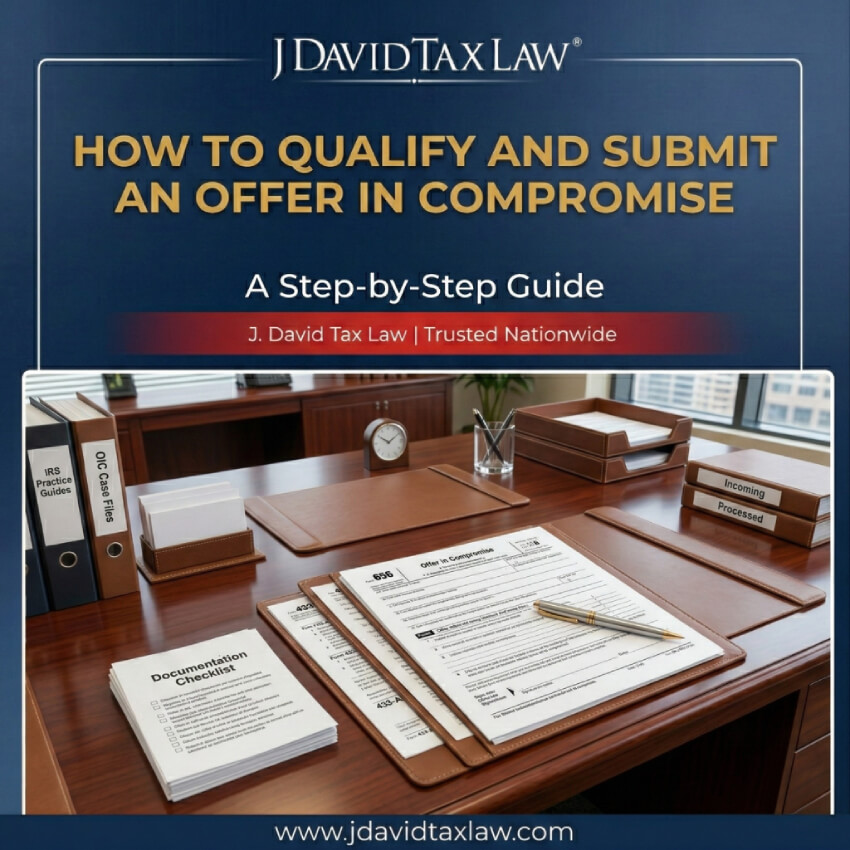
Start by assembling your Form 656 and Form 433-A (OIC) or 433-B (OIC). Double-check that every field is filled in accurately and that your financial disclosures match supporting documents. Missing or incomplete information is one of the main reasons the IRS returns applications without review.
Attach proof for all assets and income sources, including bank statements, pay stubs, mortgage documents, and vehicle titles. It’s better to over-document than to leave questions unanswered.
2. Calculate Your Offer Amount
Your proposed offer should be based on the Reasonable Collection Potential (RCP) the IRS would use to evaluate your case. This includes the equity in your assets plus a multiple of your monthly disposable income. The lower your RCP, the stronger your case for a reduced settlement.
Keep the calculation realistic. If your offer is too low compared with your financial capacity, the IRS will reject it immediately. A tax attorney can help you determine a fair and defendable figure that aligns with the IRS’s collection standards.
3. Submit with the Proper Fee and Payment
Include the $205 application fee and your initial payment with your submission, unless you qualify for a low-income waiver. The payment requirement depends on your chosen plan:
- Lump-Sum Cash Offer: Pay 20 percent of your offer upfront.
- Periodic Payment Offer: Send the first monthly payment with your application and continue making payments while the IRS reviews your case.
The IRS will return your offer without consideration if the payment is missing or incorrect.
4. Wait for Review and Respond Promptly
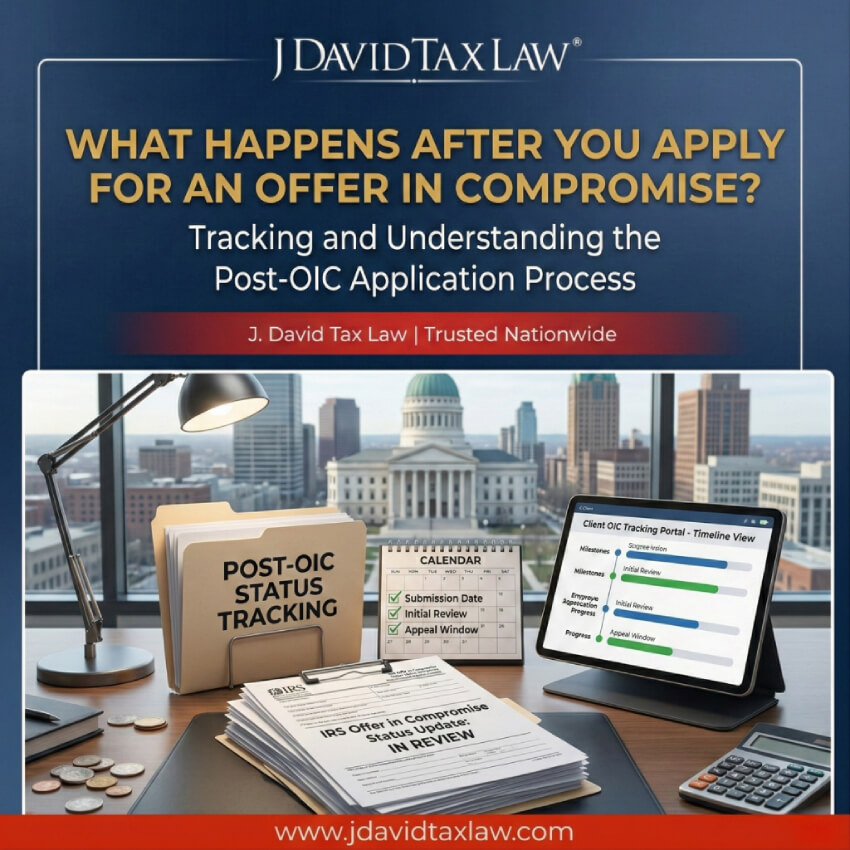
Once your offer is received, it can take six to nine months for the IRS to assign and review your case. Some offers take longer depending on complexity or workload. During this time, continue to file all new tax returns and make current payments to avoid defaulting on your compliance obligations.
If the IRS requests additional information, respond immediately. Delays or incomplete responses can cause your offer to be closed without a decision.
5. Receive Your Final Decision
After review, the IRS will either accept, reject, or return your offer.
- Accepted: You’ll receive written confirmation outlining your payment terms.
- Rejected: You have the right to appeal within 30 days using Form 13711 (Request for Appeal of Offer in Compromise).
- Returned: The IRS found a procedural issue, such as missing documents or non-compliance. You can correct and resubmit.
Pro Tip: Your Offer in Compromise becomes legally binding once accepted. Ensure that your financial information and calculations are precise and supported before signing.
Don’t Let Paperwork Derail a Life-Changing Settlement
An Offer in Compromise can transform your financial future when done correctly. It’s one of the few legal ways to reduce tax debt directly with the IRS, but success depends on accuracy, compliance, and strategy. Every form, calculation, and supporting document must reflect your true financial situation. When handled by an experienced tax attorney, your offer stands a much stronger chance of approval.
At J. David Tax Law, we approach every case with the precision the IRS expects and the care our clients deserve. We’ve guided thousands through the process, helping them achieve fair, lasting resolutions to their tax debt.
Schedule a free Offer in Compromise evaluation today.
Frequently Asked Questions About Offers in Compromise
What is an Offer in Compromise (OIC), and who qualifies?
An Offer in Compromise allows taxpayers to settle their IRS tax debt for less than the full amount owed. You may qualify if you can’t pay in full, dispute the amount, or paying would create financial hardship.
How long does the OIC process typically take?
Most Offers in Compromise take six to nine months to process from submission to decision. The timeline depends on the accuracy of your forms and how quickly you respond to IRS requests.
What documentation and financial information do I need to apply?
You’ll need Form 656, Form 433-A (OIC) or 433-B (OIC), and proof of income, expenses, and assets. The IRS uses these documents to determine your Reasonable Collection Potential (RCP) and eligibility.
What happens if my Offer in Compromise is rejected?
You can appeal within 30 days by submitting Form 13711 with supporting evidence. Many denials are overturned when financial information is clarified or updated.
Can my assets be seized while my OIC is pending?
No, the IRS typically suspends active collection while your offer is under review. Interest and penalties may still accrue until a final decision is made.